
Elderberries
Deep purple and tart. Always cooked, never raw, and stirred into something your baby already likes.
Checked against official guidance on October 18, 2026 · How we review

Quick answer
Babies can eat elderberries from around 6 months, once they show signs of being ready for solids. Prepare it as shown below.
How to serve elderberries by age
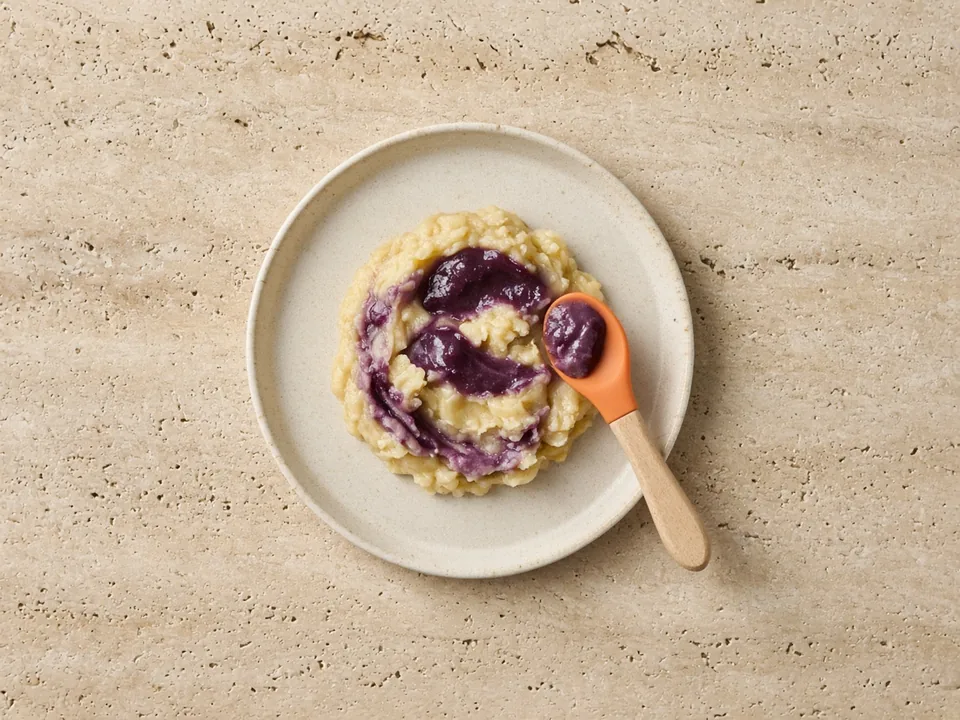
6 months+
Cooked, sieved and stirred in
Use only ripe, dark purple berries. Strip every berry off its stalk, then simmer the berries in a little water until they have all burst and softened. Push the sauce through a sieve to take out the skins and small seeds, and let it cool. Elderberries are tart, so stir the sauce into a food your baby already eats, like mashed banana, cooked apple or pear, or oatmeal. Don't add sugar.
- Size
- A teaspoon or two of cooked, sieved elderberry sauce stirred into a soft food, or served on a pre-loaded spoon. Never raw berries.
- Check before serving
- Check the sauce before serving: smooth, with no whole berries, stalks, leaves or green bits.
US and UK advice differ here. The AAP suggests mashed food or soft pieces no larger than ½ inch; the NHS suggests soft finger-sized pieces your baby can hold in their fist. Both agree the food must squash easily.
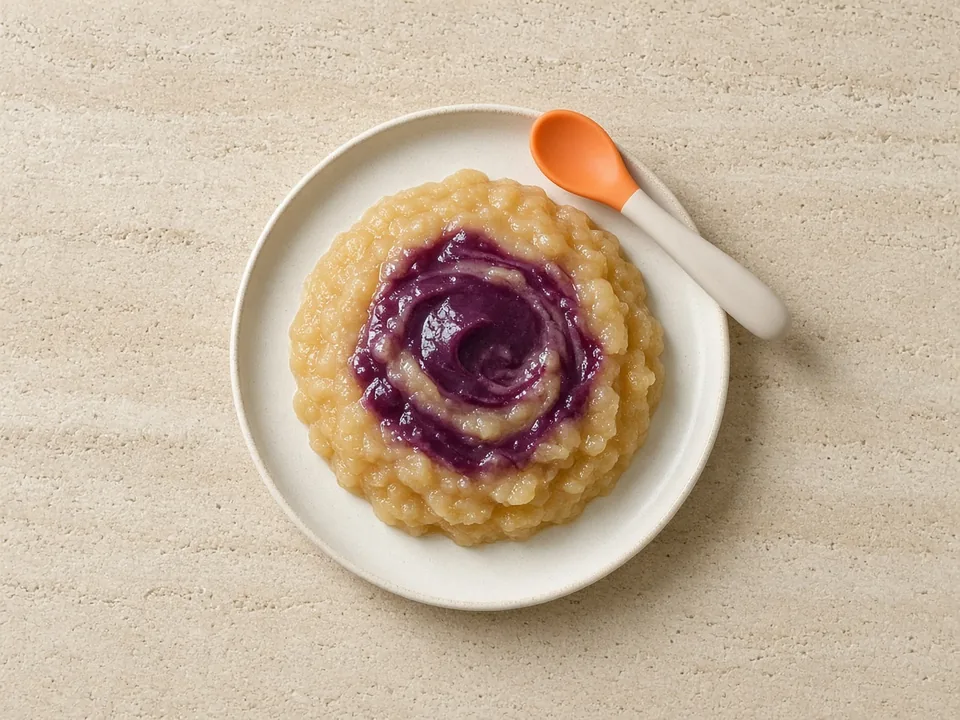
9 months+
Cooked sauce, stirred in
Keep cooking and sieving elderberries. Swirl the sauce into oatmeal, iron-fortified cereal or plain full-fat yogurt (once dairy has been introduced on its own), or into mashed cooked apple or pear.
- Size
- Cooked, sieved sauce stirred into a soft food, with any fruit served alongside in pieces no bigger than about 1 cm (just under ½ inch).
- Check before serving
- Check the sauce before serving: no whole berries, stalks or leaves, and every berry cooked until it burst.
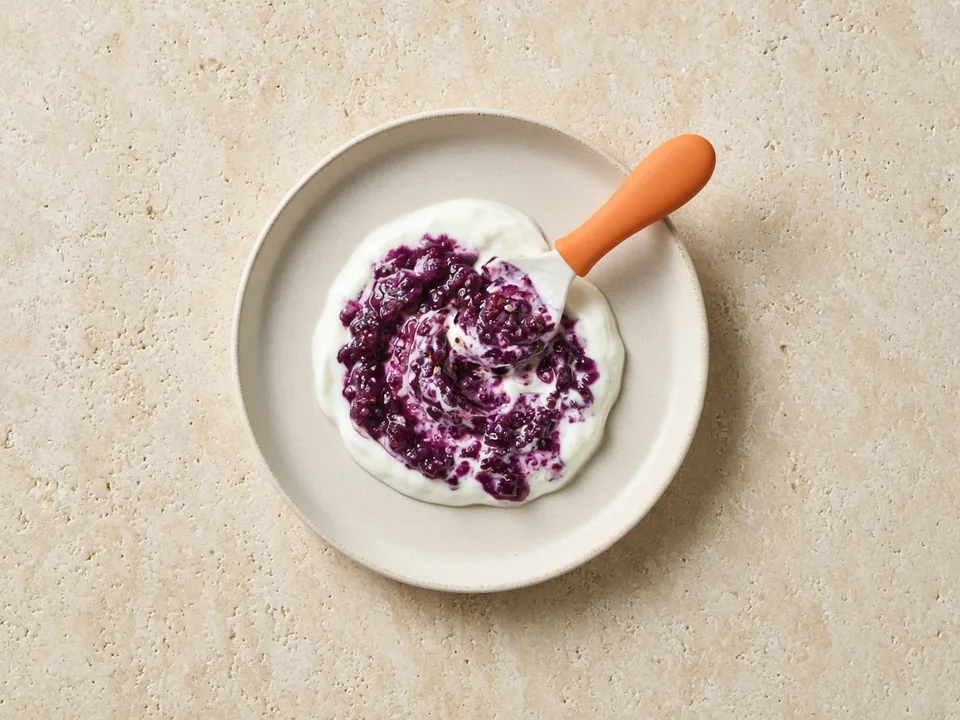
12 months+
Cooked, mashed or baked in
Elderberries are cooked at every age. You can now leave the skins and seeds in a cooked mash if your toddler manages them, or keep sieving. Stir the sauce into oatmeal or yogurt, or bake cooked elderberries into soft muffins or pancakes, without sugar. Skip sweetened elderberry jam, cordial and syrup. Stay with your toddler while they eat.
- Size
- Cooked, mashed berries, or berries cooked into soft foods, with pieces about 1 cm (just under ½ inch) or smaller.
- Check before serving
- Check before serving: every berry cooked until it burst, with no stalks, leaves or green berries.
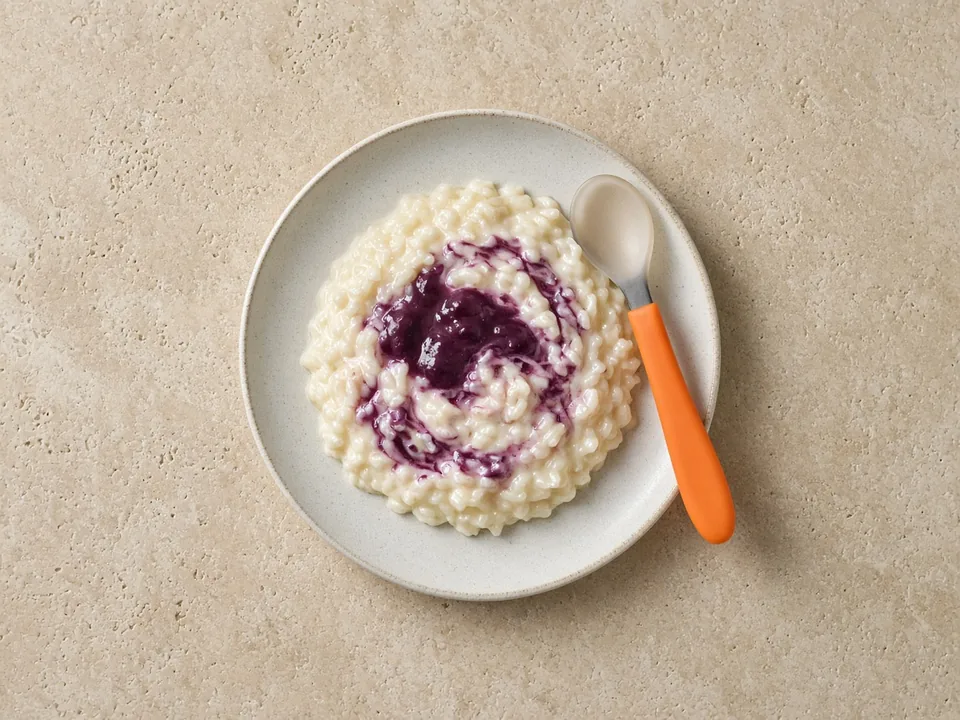
18 months+
Cooked into family foods
Cook elderberries into sauces for oatmeal, yogurt and family desserts, or bake cooked, mashed elderberries into muffins, and take your toddler's portion out before any sugar goes in. Never offer raw elderberries, even a few straight from the bush. Poison Control suggests teaching children always to ask an adult before eating or drinking anything. Make sure your toddler sits down to eat, and stay with them.
- Size
- Bite-sized pieces about 1 cm (just under ½ inch), or cooked berries in sauces and bakes.
- Check before serving
- Check before serving: every berry cooked until it burst, with no stalks, leaves or green berries.
Always have your child sit upright in a high chair or at the table, and stay with them the whole time they eat. Keep to the size and texture for their stage. Every baby develops on their own timeline.
How to prepare elderberries
- 1
Use only ripe, dark purple-black elderberries. If you pick your own, use them only if you know for certain what the plant is (Poison Control).
- 2
Rinse the clusters under running water, then strip every berry off the stalks (running a fork down each stalk works well). Pick out all stalks, leaves and green or unripe berries: the NCCIH says raw or unripe elderberries, leaves and stems contain poisonous cyanide-producing substances.
- 3
Simmer the berries in a small pan with a splash of water, stirring, until every berry has burst and softened (our suggestion: about 10 to 15 minutes; the NCCIH gives no time). The NCCIH says cooking eliminates the toxin in raw or unripe berries. Cook dried elderberries the same way (our suggestion: no source we found says drying removes the toxin).
- 4
Push the sauce through a sieve to remove the skins and seeds for babies, then let it cool before serving. Don't add sugar: stir it into a sweeter food instead.
How much to offer
Start with a teaspoon of cooked, sieved elderberry sauce stirred into a familiar food. We found no official source that gives an age for cooked elderberries: the NCCIH says cooking eliminates the toxin in raw or unripe berries, and starting small at 6 months is our suggestion. Your baby decides how much to eat: stop when they turn away or close their mouth. Elderberries are tart and strongly colored, so a little goes a long way.
Common mistakes
Serving raw elderberries
The NCCIH says raw or unripe elderberries contain cyanide-producing substances that can cause nausea, vomiting and severe diarrhea, and that cooking eliminates this toxin. Cook every berry until it bursts, at every age, and cook dried elderberries too (our suggestion).
Leaving stalks or leaves in
The leaves and stems contain the same substances (NCCIH). A CDC report describes adults who became ill after drinking juice made from wild elderberries crushed with their leaves and branches. Strip every berry off the stalk before cooking.
Giving elderberry syrup, gummies or supplements
These are sold as dietary supplements, not as food. The NCCIH says many dietary supplements haven't been tested in children, and the AAP says natural products aren't safe just because they're natural, so talk to your pediatrician first. If you're ever offered a syrup, check the label: no honey before 12 months, in any form (NHS).
Sweetening with sugar
Elderberry recipes often add a lot of sugar. Babies don't need it, and US and UK advice is to avoid added sugar up to age 4. Stir the sauce into mashed banana or cooked pear instead.
Questions parents ask
Can elderberries be a choking hazard for babies?
Whole elderberries are small and round, and the CDC lists uncut berries as a choking hazard for young children. They are also never eaten raw. Cook them until every berry bursts, then sieve or mash them, check for any whole berries or stalks, and stay with your child during meals.
Can babies be allergic to elderberries?
Elderberries are not a common allergen.
Are elderberries healthy for babies?
Raw elderberries have about 36 mg of vitamin C, 7 g of fiber and 1.6 mg of iron per 100 g (FoodData Central). A baby's spoonful of sauce gives only a little of each.
Are elderberries poisonous?
Raw or unripe elderberries, and the leaves and stems of the elder plant, contain poisonous cyanide-producing substances that can cause nausea, vomiting and severe diarrhea (NCCIH). The NCCIH says cooking eliminates this toxin, and a CDC report notes that cooked elderberries are commonly eaten in pies and jams. So use only ripe berries, strip off every stalk and leaf, and always cook them. Never give raw elderberries to a child. We found no official source that gives an age for cooked elderberries; starting small from 6 months is our suggestion.
Can I give my baby elderberry syrup for a cold?
We don't suggest it unless your pediatrician advises it. Elderberry syrups and gummies are sold as dietary supplements. The NCCIH says only preliminary research suggests elderberry may relieve cold or flu symptoms, and that many dietary supplements haven't been tested in children. The AAP says to check with your child's doctor before giving any natural product. If a syrup is ever suggested, check the label: no honey before 12 months, in any form, and no added sugar up to age 4 (NHS).
Can I use wild elderberries?
Only if you know for certain what the plant is: Poison Control says to eat wild plants only when you're sure what they are. Use only ripe, dark berries, strip off every stalk and leaf, and cook them until they burst.
If your baby refuses elderberries
- Many babies need 10 or more tries before they accept a new food. Keep offering it alongside foods they already like.
- Elderberries are tart. Mix a little sauce into mashed banana, cooked apple or pear, and slowly add more.
- Eat some yourself at the same meal. Babies copy what they see.
- Funny faces don't mean they dislike it. They're getting used to a new taste and texture.
Never force or pressure your baby to eat. Some days they'll eat more, some days less, and that's normal.
Buying and storing elderberries
- Keep fresh elderberries in the fridge, at or below 40°F (4°C), and cook them soon after picking or buying.
- Cooked elderberry sauce keeps for 3 to 4 days in a covered container in the fridge.
- Cooked, sieved elderberry sauce can be frozen in small portions and used within 3 months. Thaw it in the fridge, use it within 24 hours of thawing, and stir it into oatmeal or yogurt.
- Throw away any food left out at room temperature for more than 2 hours (1 hour if it's hotter than 90°F / 32°C).
When to talk to your doctor
Contact your pediatrician, GP or health visitor if:
- Your child has eaten raw or unripe elderberries, or chewed elder leaves, stems or bark. Get advice straight away: in the US, call Poison Help at 1-800-222-1222; in the UK, the NHS says to call 999 or go to A&E if a child may have swallowed something harmful, or to call NHS 111 if you're not sure it's harmful. If they keep vomiting, are floppy or hard to wake, have trouble breathing or have a seizure, call your emergency number.
- You're thinking of giving elderberry syrup, gummies or another supplement, or your child takes any medicine. Talk to your pediatrician first: the NCCIH says some herbs and medicines interact in harmful ways.
- You notice mild signs of an allergic reaction after eating, such as a few hives or a little vomiting. See signs of a reaction.
- You're worried about how much your baby eats, their growth, or they refuse most solid food for weeks.
Call 911999your local emergency number (such as 112 in Europe or 000 in Australia) now if your baby has trouble breathing, wheezing, can't cough or cry, has lips, mouth, tongue or throat that suddenly swell, or becomes pale, bluish, floppy or unresponsive. Also call if hives come with repeated vomiting.
Offered elderberries?
Add it to your first 100 foods.
Elderberries is in your 100 foods
1 of 100 offered · See all
Add a note (likes, dislikes, any reaction)
Saved in this browser only. Think it was a reaction? See signs of an allergic reaction and when to get help.
Helpful guides
Sources
- NIH NCCIH: Elderberry: usefulness and safety
- CDC MMWR: Poisoning from elderberry juice, California (1984)
- NIH NCCIH: 10 things to know about dietary supplements for children and teens
- AAP: Natural therapies and children: FAQs
- CDC: Choking hazards
- NHS: Foods to avoid giving babies and young children
- HHS: Fact sheet on the Dietary Guidelines for Americans, 2025–2030
- Poison Control: Poisonous and non-poisonous plants
- NHS: Poisoning
- USDA FoodData Central: Elderberries, raw
- FDA: 7 tips for cleaning fruits and vegetables
- USDA FSIS: Leftovers and food safety
- NHS Best Start in Life: Storing and reheating food
More first foods





Free printable: The First 100 Foods checklist
Tick off foods as your baby tries them. Print it or save it as a PDF, no sign-up needed.