
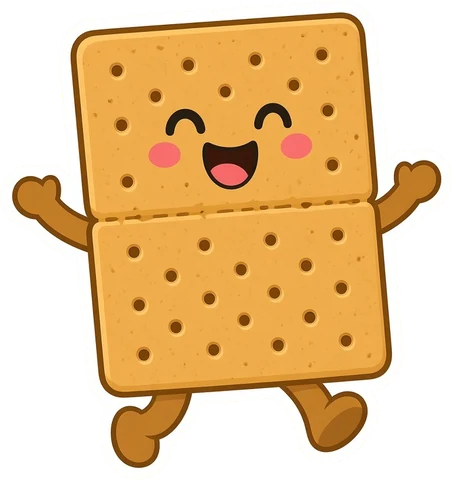
Graham crackers
A sweet cracker, sometimes made with honey. Here's why it waits, and what to offer instead.
Checked against official guidance on October 18, 2026 · How we review
Quick answer
Wait until your child is at least 4 years old before offering graham crackers. Until then, offer the safer swaps below.
How to serve graham crackers by age
Cutting photo goes here
6 months+
Not yet: soft toast strips instead
Graham crackers have added sugar, and some are made with honey. Never give honey, or foods made with it, before 12 months: it can cause infant botulism, even when baked in. Offer lightly toasted bread strips or soft ripe fruit instead.
- Size
- Instead of graham crackers, lightly toasted bread strips about the size of an adult finger, roughly 6–8 cm long and 2 cm wide (2½–3 × ¾ in).
- Check before serving
- Press a toast strip between your thumb and finger. It should feel soft inside, not snap like a cracker.
US and UK advice differ here. The AAP suggests mashed food or soft pieces no larger than ½ inch; the NHS suggests soft finger-sized pieces your baby can hold in their fist. Both agree the food must squash easily.
Cutting photo goes here
9 months+
Not yet: small soft pieces instead
Still no graham crackers, and still no honey in any form. For finger-food practice, offer small pieces of lightly toasted bread, soft-cooked pasta or ripe banana.
- Size
- Pieces no bigger than about 1 cm (just under ½ inch), of a soft food instead of graham crackers.
- Check before serving
- Each piece should squash easily between your thumb and finger.
Cutting photo goes here
12 months+
Not yet: plain crackers or toast instead
Honey is safe from 12 months as far as botulism goes, but it's an added sugar, and US and UK advice is to avoid added sugar up to age 4. For a snack, offer toast fingers, a plain low-salt cracker now and then, or soft fruit with plain yogurt.
- Size
- Bite-sized pieces about 1 cm (just under ½ inch), of a plain swap instead of graham crackers.
- Check before serving
- Read the label on any swap: no added sugar, honey or syrup.
Cutting photo goes here
18 months+
Not yet: keep sweet crackers for later
Graham crackers wait until after age 4, because of the added sugar. Watch for them at parties and in s'mores, which also have marshmallows: the CDC lists marshmallows as a choking hazard. Bring a plain snack your toddler already likes.
- Size
- Bite-sized pieces about 1 cm (just under ½ inch), of a plain swap instead of graham crackers.
- Check before serving
- Before snack time, check what older children are eating nearby.
Always have your child sit upright in a high chair or at the table, and stay with them the whole time they eat. Keep to the size and texture for their stage. Every baby develops on their own timeline.
How to prepare graham crackers
- 1
Don't buy graham crackers for your baby or toddler. They're sweetened, and some contain honey.
- 2
Never give honey grahams, or any food made with honey, to a baby under 12 months.
- 3
For a cracker-style snack from 12 months, choose plain, low-salt crackers with no honey, added sugar or seeds, or lightly toasted bread.
- 4
After age 4, offer graham crackers now and then as part of a snack, with your child sitting down.
How much to offer
None for now. Graham crackers wait until after age 4, because of the added sugar. When you offer a swap, a few pieces as part of a meal or snack is plenty. Your child decides how much to eat.
Common mistakes
Honey grahams before 12 months
Some graham crackers are made with honey. The CDC says not to give honey or products made with it to babies under 1, because it can cause infant botulism. Check the label.
Thinking they're a plain cracker
In USDA data, graham crackers have about 24.8 g of sugars per 100 g, most of it sucrose (table sugar). The CDC lists cookies among foods with added sugars, which babies and young children shouldn't have.
S'mores and toppings
S'mores add marshmallows and chocolate. Marshmallows are on the CDC choking hazard list, and both are added sugar. Keep them for much older children.
Swapping in other sweet biscuits
UK early years guidance says children under 5 shouldn't have sugar in sugary snacks, or foods high in saturated fat such as biscuits and cakes. These graham crackers are high in sugar (about 24.8 g per 100 g), though not high in saturated fat (about 1.6 g per 100 g; the NHS 'high' line is more than 5 g). Choose plain swaps instead.
Where US and UK guidance differ on graham crackers
United States(AAP and CDC)Your setting
The 2025–2030 Dietary Guidelines call on parents to avoid added sugar for children aged 4 and under. The AAP's toddler snack page says to avoid added sugar until age 2 and to serve cookies less often. The CDC says not to give honey or foods made with it to babies under 1.
United Kingdom(NHS)Your setting
The NHS says to avoid food with sugar for children aged 4 and under, including honey, and never to give honey before 12 months. UK early years guidance says children under 5 shouldn't have sugar in sugary snacks, or biscuits, which it lists among foods high in saturated fat. If you follow UK advice, keep graham crackers until after age 5.
We cover US and UK guidance in detail. Elsewhere, check your national health service's advice too.
Questions parents ask
Can graham crackers be a choking hazard for babies?
Graham crackers are a dry, crumbly cookie, and the CDC lists cookies among choking hazards for young children. It also advises avoiding small, sticky or hard foods that are difficult to chew and swallow, and having your child sit up while eating. When your child is old enough for them, break them into pieces, keep s'mores and marshmallows out, and stay with your child while they eat.
Can babies be allergic to graham crackers?
Graham crackers are made from wheat, and some also contain milk or soy. Chocolate-coated ones can contain milk and other allergens. Honey isn't an allergen, but it's a reason to avoid them before 12 months. Read the label every time, as recipes change.
Are graham crackers healthy for babies?
Graham crackers are a sweet baked food. In USDA data they have about 24.8 g of sugars per 100 g (22.8 g of it sucrose), above the NHS 'high sugar' line of 22.5 g, plus 516 mg of sodium (about 1.3 g of salt) and 3.8 mg of iron. Plain toast or fruit gives a toddler energy without the added sugar.
When can kids have graham crackers?
US and UK advice is to avoid added sugar for children aged 4 and under, so graham crackers are best left until after age 4 (after age 5 if you follow UK early years guidance). Graham crackers made with honey must never be given before 12 months, because honey can cause infant botulism.
Are honey graham crackers safe for babies?
No. The CDC says not to give honey or products made with it to babies under 1, and the NHS says to avoid honey until 12 months. Baking doesn't make it safe.
My baby under 1 ate a honey graham cracker. What should I do?
Don't panic: infant botulism is rare. Watch your baby over the next few weeks; the AAP says signs can start 3 to 30 days after exposure. If they become constipated, call your pediatrician the same day and tell them about the honey. If they feed poorly, have a weak or different cry, drooping eyelids, poor head control, or seem weak or floppy, call your emergency number.
If your baby refuses graham crackers
- Graham crackers aren't a food to offer yet, so there's nothing to keep trying.
- If your toddler asks for them when others are eating them, offer a plain snack they already like, such as toast fingers or soft fruit.
- Bring your own plain snack to parties and playdates, so there's an easy swap.
- A calm 'not yet' works better than a long explanation. Keeping the box out of sight helps too.
Never force or pressure your baby to eat. Some days they'll eat more, some days less, and that's normal.
Buying and storing graham crackers
- Keep graham crackers in a sealed pack or airtight container in a cool, dry place, up high and out of your child's reach.
- Check pantry snacks for honey before sharing anything with a baby under 12 months.
- Throw away any food left out at room temperature for more than 2 hours (1 hour if it's hotter than 90°F / 32°C).
When to talk to your doctor
Contact your pediatrician, GP or health visitor if:
- Your baby is under 12 months, has had a honey graham cracker or any food made with honey, and then becomes constipated. Constipation is often the first sign of infant botulism, so call your pediatrician the same day and tell them about the honey.
- Your baby is under 12 months, has had honey in any form, and then has poor feeding, a weak or different cry, drooping eyelids, less facial movement, poor head control, or seems weak or floppy, with or without constipation. Call your emergency number or go to the emergency room now: these can be signs of infant botulism, which is a medical emergency.
- Your child has had any reaction to wheat, even a mild one. Stop offering wheat foods until you've talked to your pediatrician.
- You notice mild signs of an allergic reaction after eating, such as a few hives or a little vomiting. See signs of a reaction.
- You're worried about how much your baby eats, their growth, or they refuse most solid food for weeks.
Call 911999your local emergency number (such as 112 in Europe or 000 in Australia) now if your baby has trouble breathing, wheezing, can't cough or cry, has lips, mouth, tongue or throat that suddenly swell, or becomes pale, bluish, floppy or unresponsive. Also call if hives come with repeated vomiting.
Offered graham crackers?
Add it to your first 100 foods.
Graham crackers is in your 100 foods
1 of 100 offered · See all
Last offered today. Once graham crackers is in your baby's diet, keep offering it regularly.
Add a note (likes, dislikes, any reaction)
Saved in this browser only. Think it was a reaction? See signs of an allergic reaction and when to get help.
Helpful guides
Sources
- HHS: Fact sheet on the Dietary Guidelines for Americans, 2025–2030
- NHS: Foods to avoid giving babies and young children
- CDC: Foods and drinks to avoid or limit
- CDC: Botulism prevention
- AAP: Botulism: causes, signs, symptoms and treatment
- AAP: Building balanced snacks to feed to toddlers
- CDC: Choking hazards
- Department for Education: Food safety (Help for early years providers)
- NHS: Food labels
- USDA FoodData Central: Cookies, graham crackers, plain or honey
- USDA FSIS: Leftovers and food safety
More first foods

Free printable: The First 100 Foods checklist
Tick off foods as your baby tries them. Print it or save it as a PDF, no sign-up needed.