
Ground beef
Soft patties, or crumbles stirred into sauce: a quick family staple, cooked all the way through.
Checked against official guidance on October 18, 2026 · How we review

Quick answer
Babies can eat ground beef from around 6 months, once they show signs of being ready for solids. Prepare it as shown below.
How to serve ground beef by age
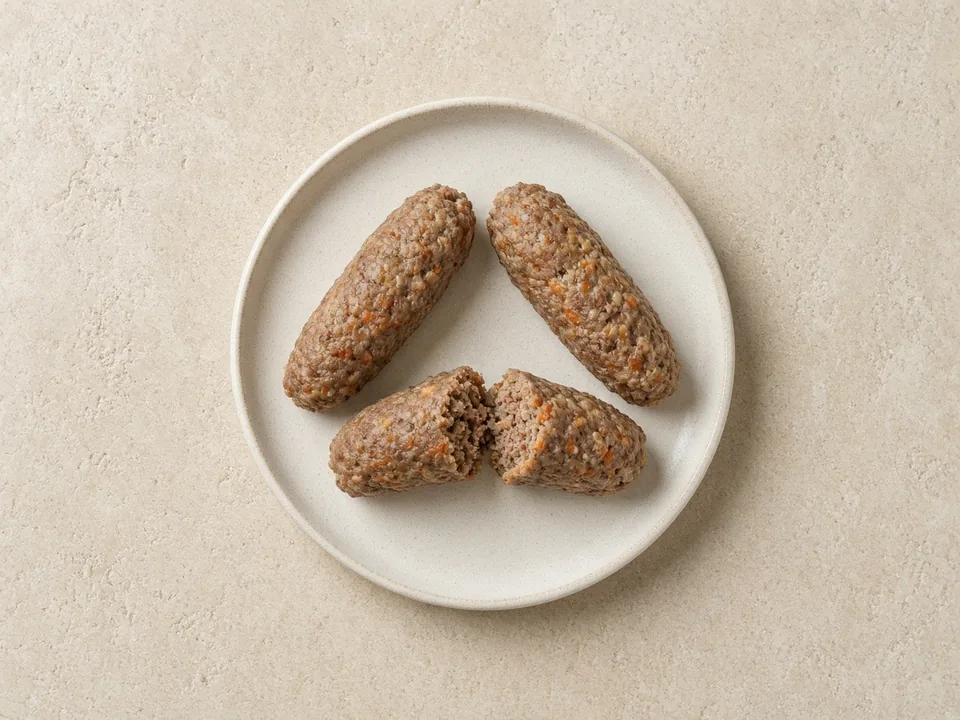
6 months+
Soft patty fingers, or crumbles mashed into sauce
Mix ground beef with a little mashed potato or finely grated vegetable, shape soft fingers, and cook them to 160°F (71°C) in the center. Or brown it in a pan until it reaches 160°F (71°C), then blend or mash the crumbles finely into a thick sauce or mashed potato, so the meat holds together instead of rolling around as loose, dry bits.
- Size
- Finger-shaped patties about the size of an adult finger, roughly 6–8 cm long and 2 cm wide (2½–3 × ¾ in), or cooked crumbles mashed finely into a thick sauce or mash.
- Check before serving
- Squash a patty finger between your thumb and finger. It should break apart easily. If it's springy or dry, crumble it into sauce or mash instead.
US and UK advice differ here. The AAP suggests mashed food or soft pieces no larger than ½ inch; the NHS suggests soft finger-sized pieces your baby can hold in their fist. Both agree the food must squash easily.
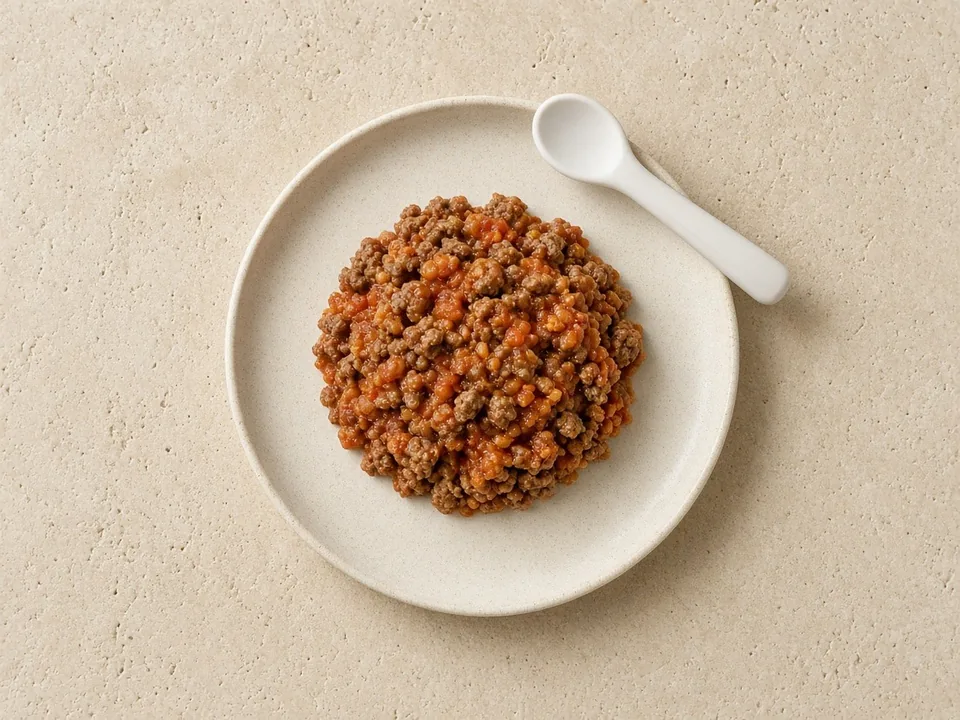
9 months+
Small crumbles in sauce, or patty pieces
Stir cooked crumbles into a moist pasta sauce, lentils or mashed vegetables, or break a soft patty into small pieces for pincer-grasp practice. Keep it moist: dry, hard crumbles are harder to manage.
- Size
- Pieces no bigger than about 1 cm (just under ½ inch).
- Check before serving
- Each piece should squash flat between your thumb and finger. Skip crisp, browned edges.
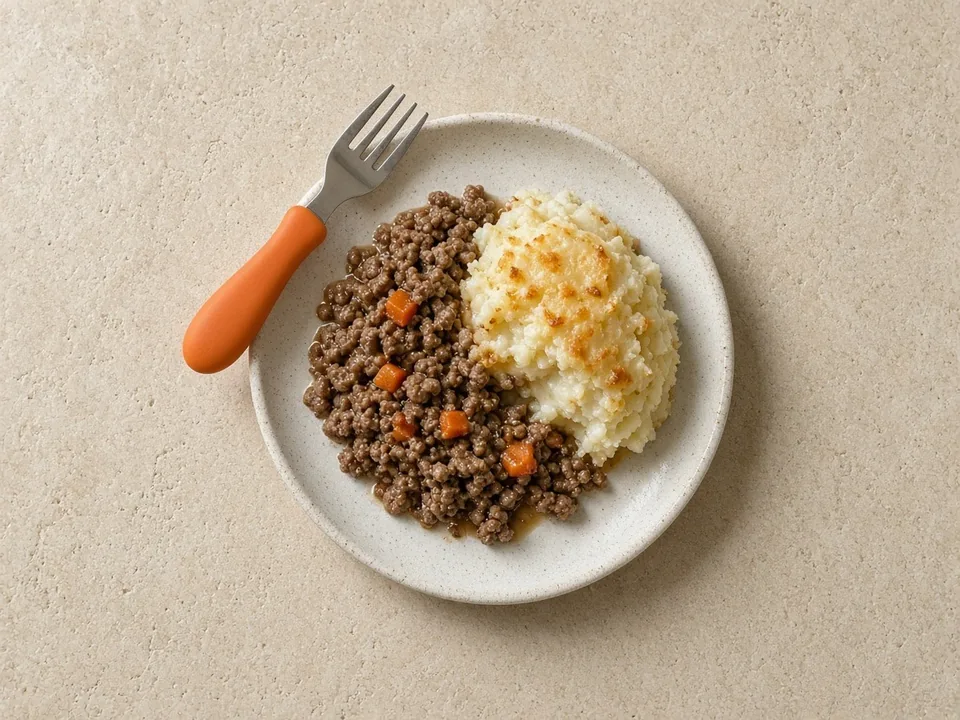
12 months+
Ground beef in family meals
Serve ground beef from family meals: pasta sauce, cottage pie, chili without the heat, or soft tacos cut into strips. Cut meatballs and patties into pieces about 1 cm (just under ½ inch). Take your toddler's portion out before you add salt, stock cubes or seasoning mixes.
- Size
- Bite-sized pieces about 1 cm (just under ½ inch).
- Check before serving
- Pieces should pull apart easily with a fork and be moist all the way through.
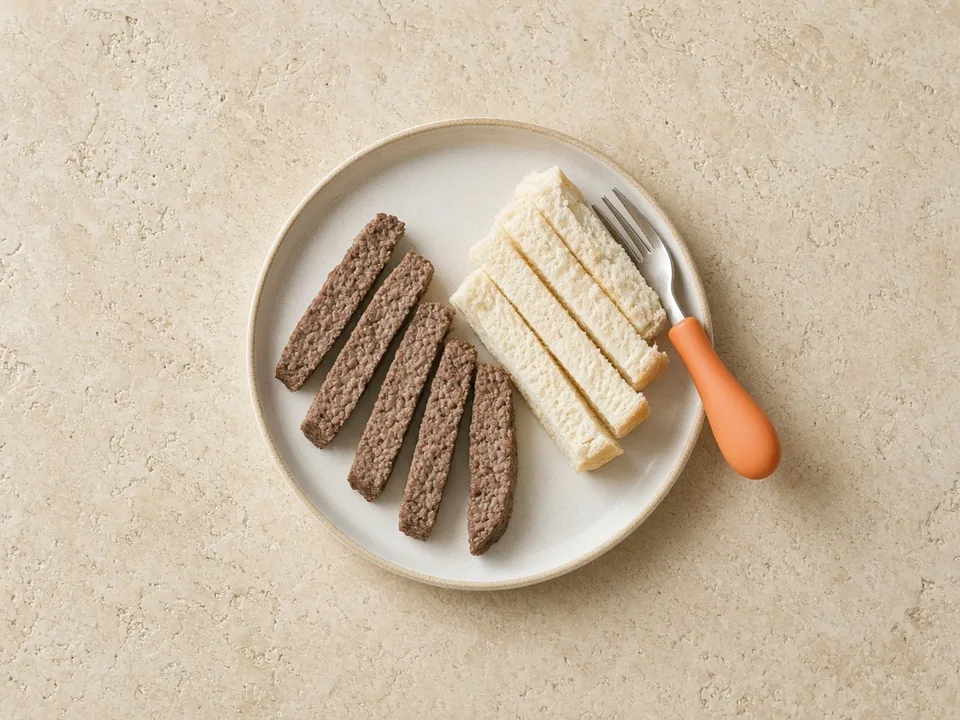
18 months+
Family dishes, burgers cut up
Offer ground beef the way your family eats it. Cut burgers into strips or small pieces rather than serving them whole, and cut meatballs small: whole ones are round and can be firm. Shop-bought frozen meatballs and takeaway burgers are salty (the NHS lists takeaways among salty foods), so keep them occasional, as on our burger and meatballs pages.
- Size
- Bite-sized pieces about 1 cm (just under ½ inch), or narrow strips.
- Check before serving
- Still check that there are no large chunks and that each piece pulls apart easily.
Always have your child sit upright in a high chair or at the table, and stay with them the whole time they eat. Keep to the size and texture for their stage. Every baby develops on their own timeline.
How to prepare ground beef
- 1
Thaw frozen ground beef in the fridge, or in cold water in a sealed bag (change the water every 30 minutes), or in the microwave. Cook it straight away after cold-water or microwave thawing. Never thaw it on the counter.
- 2
Don't rinse raw ground beef. Wash your hands with soap and water for 20 seconds before and after handling it, and keep it and its juices away from food that won't be cooked. Don't taste the raw mixture.
- 3
Cook it all at once, never part-cooked to finish later. Brown crumbles in a pan, breaking them up, or cook patties, until the center reaches 160°F (71°C) on a food thermometer. For thin patties, slide the thermometer in sideways. Don't add salt.
- 4
If you used regular ground beef, spoon off the melted fat. Let it cool, then shape, mash or cut it for your baby's stage, and do the squash test.
How much to offer
Start with a patty finger or two, or a spoonful of crumbles mashed into sauce. Your baby decides how much to eat: stop when they turn away or close their mouth. Lots of sucking and chewing with little swallowed is normal at first.
Common mistakes
Guessing when it's done
Grinding mixes any bacteria on the surface all the way through the meat, and USDA FSIS says children under 5 are among those most at risk from undercooked ground beef. Check that patties and crumbles reach 160°F (71°C) with a food thermometer.
Thawing it on the counter
USDA FSIS says perishable food should never be thawed on the counter: the outside can warm up enough for bacteria to grow while the middle is still frozen. Thaw it in the fridge, in cold water, or in the microwave.
Part-cooking it to finish later
USDA FSIS says partly cooking ground beef ahead of time lets bacteria survive and multiply to a point that later cooking can't fix. Cook it all the way through in one go.
Seasoning mixes, stock cubes or salty sauces
Babies shouldn't have added salt, and the NHS says not to use stock cubes or gravy for them. Seasoning mixes can contain salt, so check the label, or take your baby's portion out before seasoning.
Where US and UK guidance differ on ground beef
United States(AAP and CDC)Your setting
USDA FSIS says to cook ground beef to 160°F (71°C), measured with a food thermometer, and the CDC lists raw or undercooked meat as a riskier choice for children under 5. FSIS says ground beef thawed in the fridge can be refrozen without cooking.
United Kingdom(NHS)Your setting
The NHS doesn't give temperatures. It says to cook burgers all the way through, until no pink or red meat is left and the juices run clear. It says to thaw meat in the fridge and use it within 2 days, or defrost it in the microwave only if you'll cook it straight away, and that defrosted raw meat can be frozen again once it has been cooked thoroughly.
We cover US and UK guidance in detail. Elsewhere, check your national health service's advice too.
Questions parents ask
Can ground beef be a choking hazard for babies?
Ground beef is a medium choking risk. The CDC lists tough or large chunks of meat as a choking hazard for young children, and dry, firm crumbles and whole meatballs are hard for babies to manage. Serve soft patty fingers, crumbles mashed into a moist sauce, or, from 9 months, pieces no bigger than about 1 cm (just under ½ inch). Stay with your child during meals.
Can babies be allergic to ground beef?
Beef is not one of the common food allergens. Patties and meatballs often contain breadcrumbs (wheat), egg or cheese (milk), and seasoning mixes can contain other allergens, so check labels and introduce each allergen on its own first. If you use breadcrumbs for a baby under 12 months, check the label for honey, which isn't safe before 12 months (NHS).
Is ground beef healthy for babies?
A source of protein, iron and zinc. FoodData Central lists about 3.2 mg of iron and 7.6 g of fat per 100 g of pan-browned 95% lean ground beef, and about 2.5 mg of iron and 17.9 g of fat for 70% lean. The iron in beef includes heme iron, which the body absorbs more easily than the nonheme iron in plant foods (NIH). Babies aged 7 to 12 months need 11 mg of iron a day from all their food.
Should I buy lean or regular ground beef for my baby?
Either works. Leaner ground beef has a little more iron and much less fat per 100 g once cooked (see nutrition), but it cooks firmer and drier, so keep it moist with sauce or mash. The CDC suggests removing fat from meat before cooking it for babies. You can't trim ground beef, so with regular ground beef, spoon off the melted fat after browning (our suggestion).
How long does raw ground beef keep?
In the fridge at 40°F (4°C) or below, cook or freeze it within 1 to 2 days of buying it (USDA FSIS). In the freezer it stays safe as long as it's frozen, but it's best used within 3 to 4 months, so write the date on the pack. Once thawed in the fridge, cook it within 1 to 2 days.
Can I cook ground beef from frozen?
Yes. USDA FSIS says it's safe to cook meat from frozen; it takes about one and a half times as long. It still needs to reach 160°F (71°C) all the way through, so check with a food thermometer.
How do I make ground beef soft enough for a baby?
Mix in a little mashed potato or grated vegetable before shaping patties, handle the mixture lightly, and don't overcook it past 160°F (71°C). For crumbles, stir them into a sauce or mash, then blend or mash them finely for young babies.
If your baby refuses ground beef
- Many babies need 10 or more tries before they accept a new food. Keep offering it alongside foods they already like.
- Try another form: patty fingers, crumbles in pasta sauce, or mashed into potato.
- Moisten dry meat with a little no-salt-added tomato sauce, breast milk or formula.
- Eat some yourself at the same meal. Babies copy what they see.
Never force or pressure your baby to eat. Some days they'll eat more, some days less, and that's normal.
Buying and storing ground beef
- Keep raw ground beef in a sealed container on the bottom shelf of the fridge, at 40°F (4°C) or below, and cook or freeze it within 1 to 2 days. Frozen raw ground beef is best used within 3 to 4 months.
- Ground beef thawed in the fridge should be cooked within 1 to 2 days. If you thawed it in cold water or the microwave, cook it straight away.
- Cooked patties, crumbles and meat sauce keep for 3 to 4 days in a covered container in the fridge, or 2 to 3 months in the freezer. Reheat only once, to 165°F (74°C), until steaming hot, then let it cool before serving.
- Throw away any food left out at room temperature for more than 2 hours (1 hour if it's hotter than 90°F / 32°C).
When to talk to your doctor
Contact your pediatrician, GP or health visitor if:
- Your child has diarrhea, vomiting or tummy cramps after eating ground beef that may have been undercooked. Call your pediatrician for bloody poop, a fever higher than 102°F (39°C), diarrhea or vomiting lasting more than 2 days, or signs of dehydration such as very dark pee, a dry mouth or crying without tears. Call your emergency number for blood in the pee, very little or no pee, losing the pink color in the cheeks or inside the lower eyelids, unexplained bruising or a rash of tiny red spots, or being very tired, cranky or less alert: these can be signs of hemolytic uremic syndrome (HUS), a serious complication that can damage the kidneys.
- You notice mild signs of an allergic reaction after eating, such as a few hives or a little vomiting. See signs of a reaction.
- You're worried about how much your baby eats, their growth, or they refuse most solid food for weeks.
Call 911999your local emergency number (such as 112 in Europe or 000 in Australia) now if your baby has trouble breathing, wheezing, can't cough or cry, has lips, mouth, tongue or throat that suddenly swell, or becomes pale, bluish, floppy or unresponsive. Also call if hives come with repeated vomiting.
Offered ground beef?
Add it to your first 100 foods.
Ground beef is in your 100 foods
1 of 100 offered · See all
Add a note (likes, dislikes, any reaction)
Saved in this browser only. Think it was a reaction? See signs of an allergic reaction and when to get help.
Helpful guides
Sources
- USDA FSIS: Ground beef and food safety
- USDA FSIS: Freezing and food safety
- USDA FSIS: The big thaw, safe defrosting methods
- CDC: Safer food choices for children under 5
- CDC: Choking hazards
- CDC: When, what, and how to introduce solid foods
- CDC: Symptoms of E. coli infection
- NHS: Meat in your diet
- NHS: Foods to avoid giving babies and young children
- NIH Office of Dietary Supplements: Iron
- USDA FoodData Central: Beef, ground, 95% lean meat / 5% fat, crumbles, cooked, pan-browned
- USDA FoodData Central: Beef, ground, 70% lean meat / 30% fat, crumbles, cooked, pan-browned
- NHS Best Start in Life: Storing and reheating food
- NHS: Help your baby enjoy new foods
More first foods





Free printable: The First 100 Foods checklist
Tick off foods as your baby tries them. Print it or save it as a PDF, no sign-up needed.