
Salsa
Tomato, onion and a squeeze of lime. Cooked soft and kept mild, it's a family sauce your baby can share.
Checked against official guidance on October 18, 2026 · How we review
Quick answer
Babies can eat salsa from around 6 months, once they show signs of being ready for solids. Prepare it as shown below.
How to serve salsa by age
6 months+
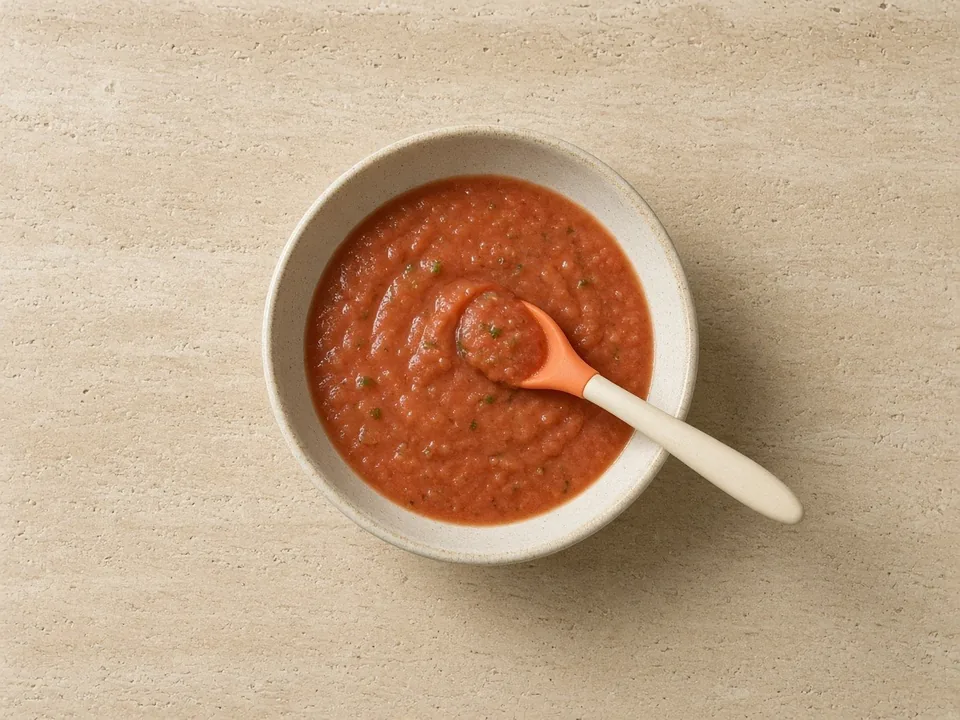
Cooked, blended tomato salsa, no salt
Make a cooked salsa: simmer peeled, chopped ripe tomatoes with finely chopped onion until both are very soft. Stir in a little finely chopped cilantro while it's still hot and let it cook for a minute or two, then blend or mash. Add a few drops of lime if you like. Leave out salt and chili, or cook in only a hint of seeded jalapeño (see our jalapeño page). Serve it on a spoon, as a dip, or stirred into mashed beans or rice.
- Size
- Smooth on a pre-loaded spoon, or as a dip for soft-cooked vegetable sticks about the size of an adult finger, roughly 6–8 cm long and 2 cm wide (2½–3 × ¾ in).
- Check before serving
- Taste it first: it should be mild, with no heat. Check there are no firm bits of onion.
US and UK advice differ here. The AAP suggests mashed food or soft pieces no larger than ½ inch; the NHS suggests soft finger-sized pieces your baby can hold in their fist. Both agree the food must squash easily.
9 months+
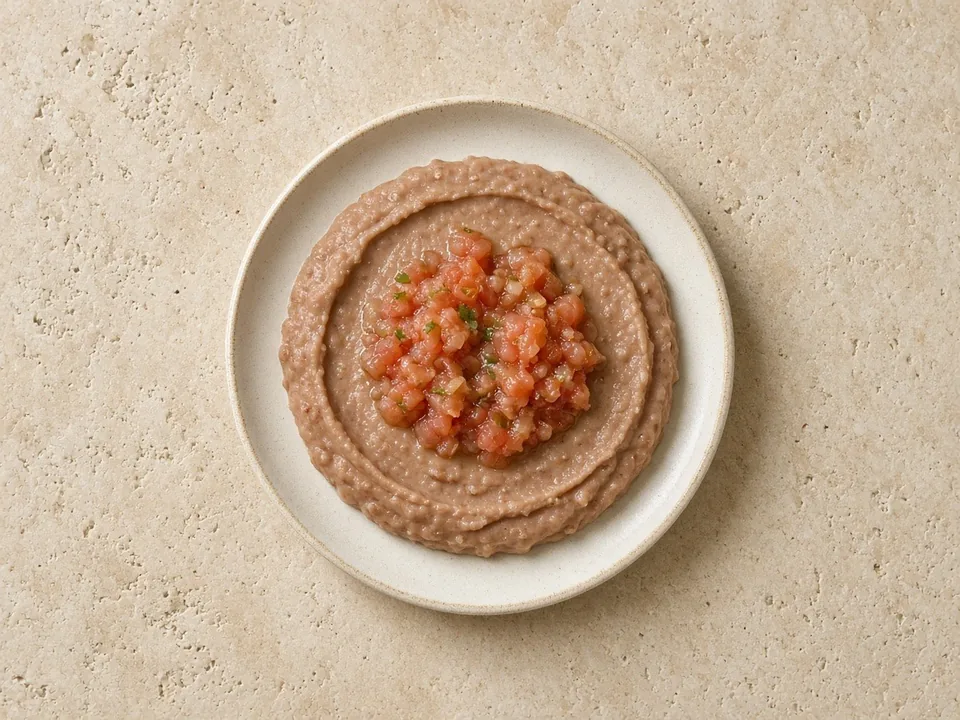
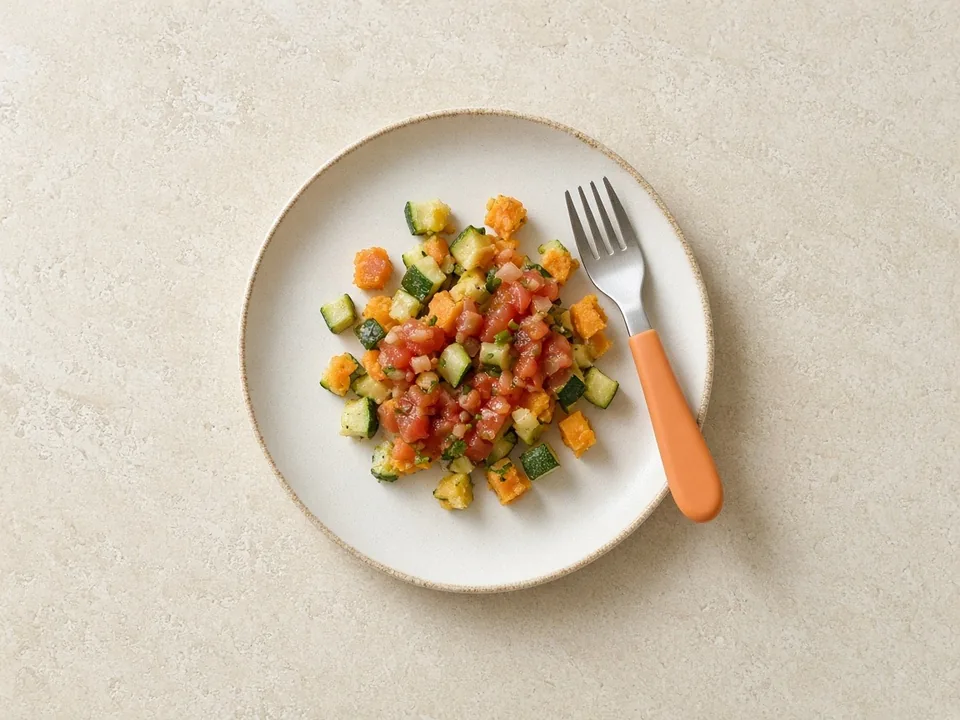
Soft, finely chopped salsa
Leave the cooked salsa a little chunkier, or offer finely chopped, peeled ripe raw tomato with soft-cooked onion stirred in. Spoon it over mashed beans, scrambled egg (once egg has been introduced on its own) or soft quesadilla strips. Still no salt or real heat. For raw tomato, see the guidance note below.
- Size
- Finely chopped, with soft pieces no bigger than about 1 cm (just under ½ inch).
- Check before serving
- Squash a piece of tomato and onion between your thumb and finger: each should flatten easily.
12 months+
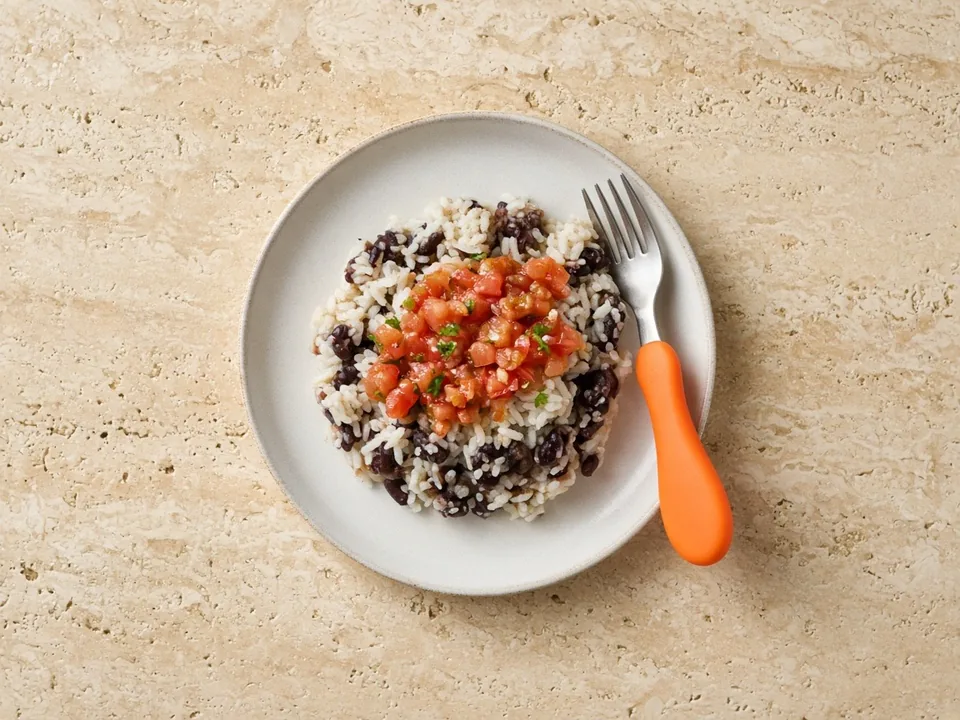
Homemade fresh or cooked salsa
Fresh salsa works if the tomato is ripe and soft and the onion and any jalapeño are cooked soft, or blended smooth so there are no crunchy raw pieces. Take your toddler's portion out before salt and chili go in. Jarred salsa is salty, about 1.8 g of salt per 100 g, so if you use it, a small spoonful now and then is plenty. Keep tortilla chips for the adults: the CDC lists chips as a choking hazard.
- Size
- Finely chopped, on bite-sized pieces about 1 cm (just under ½ inch) of the foods you serve it with.
- Check before serving
- Check your toddler's portion for crunchy pieces of onion or chili, and taste it for heat.
18 months+
Mild salsa with family meals
Spoon mild salsa onto soft tacos, eggs, rice and beans, or use it as a dip for soft-cooked vegetables. Keep the onion and any jalapeño cooked soft, or blended smooth, so there are no crunchy raw pieces, and keep the heat mild (see our onion and jalapeño pages). If you buy jarred salsa, choose a mild, smooth one, use a small spoonful, and keep hot or chunky raw salsa for the adults.
- Size
- Finely chopped, as a topping or dip, with bite-sized pieces about 1 cm (just under ½ inch).
- Check before serving
- Taste a spoonful of your toddler's portion: it should taste mild, not salty or hot.
Always have your child sit upright in a high chair or at the table, and stay with them the whole time they eat. Keep to the size and texture for their stage. Every baby develops on their own timeline.
How to prepare salsa
- 1
Wash your hands. Rinse the tomatoes, onion, cilantro and any chili under running water.
- 2
Peel the tomatoes and onion for babies, as the NHS advises for raw fruit and vegetables, and chop them finely.
- 3
For babies under 12 months, simmer the tomatoes and onion until very soft, then blend or mash. Don't add salt.
- 4
If you use chili, wear gloves, scrape out the seeds and white ribs, and keep it out of your baby's portion or cook in only a hint.
- 5
Take your child's portion out before you add salt, more chili or hot sauce for the adults, and let it cool before serving.
How much to offer
Start with a teaspoon or two, as a dip or stirred into food. Salsa is a flavor, so there's no amount to aim for. Your baby decides how much to eat: stop when they turn away or close their mouth. If it seems too sharp or hot for them, go back to a milder version and try again another time.
Common mistakes
Using jarred salsa for babies
FoodData Central lists ready-to-serve salsa at about 711 mg of sodium per 100 g (about 1.8 g of salt), above the NHS high line of 1.5 g of salt per 100 g. Babies under 1 should have less than 1 g of salt a day. Make your own without salt.
Thinking fresh salsa is unsalted
Pico de gallo usually has salt added too: FoodData Central lists it at about 443 mg of sodium per 100 g (about 1.1 g of salt). Take your child's portion out before the salt goes in.
Making it too hot
Poison Control says too much hot pepper can cause nausea, vomiting, belly pain, diarrhea and a burning feeling. Keep your child's portion mild, and add heat to the adults' plates.
Cutting chili with bare hands
Poison Control says capsaicin, the hot part of chili peppers, can be intensely irritating to the skin and eyes. Wear gloves, don't touch your face or eyes, and wash your hands, knife and board before you touch your child or their food.
Where US and UK guidance differ on salsa
United States(AAP and CDC)Your setting
For babies under 1, the AAP says that apart from mashed banana, most fruits and vegetables should be cooked until soft, and that fresh baby food should be cooked with no added salt or seasoning. If you follow US advice, cook the salsa soft for the first year and leave chili out until 12 months. The CDC says to avoid feeding young children foods high in salt (sodium).
United Kingdom(NHS)Your setting
The NHS lists slices of soft fruit as finger foods from around 6 months, says to wash and peel raw fruit and vegetables, and says not to add salt to your baby's food. Its weaning recipes include a dhal from 6 months made with chili powder, described as a way to introduce mild spices. Keep raw tomato ripe and soft, and any chili mild.
We cover US and UK guidance in detail. Elsewhere, check your national health service's advice too.
Questions parents ask
Can salsa be a choking hazard for babies?
Salsa is soft, but it can hold firm pieces: raw onion and chili are firm and crunchy, and the CDC lists pieces of hard raw vegetables as a choking hazard. For babies, cook the salsa soft and blend or mash it. For toddlers, keep the onion and any chili cooked soft or blended smooth, with no crunchy raw pieces. Tortilla chips are a choking hazard for young children (CDC), so offer soft foods for dipping. Stay with your child during meals.
Can babies be allergic to salsa?
Salsa is not a common allergen. Raw tomato can leave a red rash around the mouth where it touches the skin: see our tomato page for how to tell this apart from an allergy. Jarred salsas can contain other ingredients, such as celery, which the NHS lists among foods that can trigger allergy, so read the label.
Is salsa healthy for babies?
Mostly tomato, onion and water: 100 g of ready-to-serve salsa has about 29 kcal and 1.9 g of fiber, with about 711 mg of sodium (about 1.8 g of salt). Homemade salsa without salt has very little sodium. A spoonful adds flavor, not nutrients to count on.
Can babies eat salsa?
Yes, from around 6 months, if it's homemade, cooked soft and made without salt or real heat. Jarred salsa is salty, so keep it for after 12 months, in small amounts.
Can babies eat spicy salsa?
No official source sets an age for chili heat. The NHS has a dhal for babies from 6 months made with half a teaspoon of chili powder for 8 portions, and calls it a way to introduce mild spices. The AAP says fresh baby food should be cooked with no added seasoning. If you share salsa, keep your child's portion mild: see the guidance note below.
What if my child's mouth burns after salsa?
Poison Control says small sips of milk or water may help with the burning. Offer your baby their usual milk, or some water in a cup, and make their portion milder next time.
Is jarred salsa OK for toddlers?
Now and then, in small amounts. At about 1.8 g of salt per 100 g, jarred salsa is high in salt by the NHS measure, and children aged 1 to 3 should have no more than 2 g of salt a day. Choose mild, compare labels for a lower-salt one, and use a spoonful rather than a bowl to dip into.
If your baby refuses salsa
- Many babies need 10 or more tries before they accept a new food. Keep offering it alongside foods they already like.
- Try it cooked and smooth, stirred into beans, rice or eggs, rather than as a dip.
- Use less onion and lime, so it tastes milder.
- Eat some yourself at the same meal. Babies copy what they see.
Never force or pressure your baby to eat. Some days they'll eat more, some days less, and that's normal.
Buying and storing salsa
- Once opened, keep jarred salsa in the fridge, and follow the label for how long it keeps.
- Homemade salsa keeps for 3 to 4 days in a covered container in the fridge.
- Cooked salsa can be frozen in small portions for 2 to 3 months. Thaw it in the fridge, use it within 24 hours of thawing, and reheat it only once, to a rolling boil or 165°F (74°C), then let it cool before serving.
- Throw away any food left out at room temperature for more than 2 hours (1 hour if it's hotter than 90°F / 32°C).
When to talk to your doctor
Contact your pediatrician, GP or health visitor if:
- After eating very hot salsa, your child has diarrhea or belly pain, or vomits once, and you're worried. Call Poison Help (1-800-222-1222) in the US or NHS 111 in the UK for advice. If they vomit again and again, have trouble breathing, or become floppy or very sleepy, call your emergency number.
- Chili juice got into your child's eye. Rinse it with lots of room-temperature water for at least 15 to 20 minutes, then call Poison Help (1-800-222-1222) in the US or NHS 111 in the UK. If the pain, redness, swelling or tearing is severe, or hasn't settled an hour after you started rinsing, or your child seems to have trouble seeing, go to the emergency room (A&E in the UK) straight away.
- You notice mild signs of an allergic reaction after eating, such as a few hives or a little vomiting. See signs of a reaction.
- You're worried about how much your baby eats, their growth, or they refuse most solid food for weeks.
Call 911999your local emergency number (such as 112 in Europe or 000 in Australia) now if your baby has trouble breathing, wheezing, can't cough or cry, has lips, mouth, tongue or throat that suddenly swell, or becomes pale, bluish, floppy or unresponsive. Also call if hives come with repeated vomiting.
Add a note (likes, dislikes, any reaction)
Saved in this browser only. Think it was a reaction? See signs of an allergic reaction and when to get help.
Helpful guides
Sources
- AAP: When can babies start solid foods?
- NHS: Your baby's first solid foods
- NHS: Food allergies in babies and young children
- NHS: Salt in your diet
- NHS: Food labels
- NHS Best Start in Life: Delicious dhal
- CDC: Choking hazards
- CDC: Foods and drinks to avoid or limit
- Poison Control: Capsaicin: When the chili is too hot
- Poison Control: First aid for poisonings
- FDA: 7 tips for cleaning fruits and vegetables
- USDA FoodData Central: Sauce, salsa, ready-to-serve
- USDA FoodData Central: Salsa, pico de gallo
- FoodSafety.gov: Cold food storage chart
- USDA FSIS: Leftovers and food safety
- NHS Best Start in Life: Storing and reheating food
More first foods

Free printable: The First 100 Foods checklist
Tick off foods as your baby tries them. Print it or save it as a PDF, no sign-up needed.