
Waffles
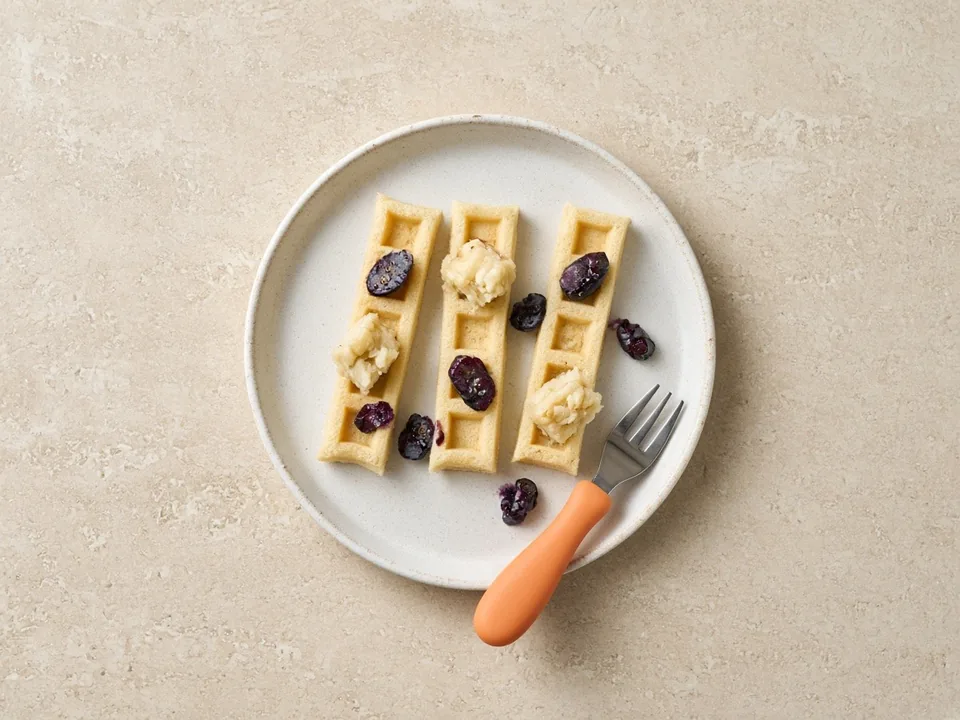
Soft homemade waffles make easy strips to hold. Fruit on top, no syrup needed.
Checked against official guidance on October 18, 2026 · How we review
Quick answer
Babies can eat waffles from around 6 months, once they show signs of being ready for solids. Prepare it as shown below.
How to serve waffles by age
6 months+
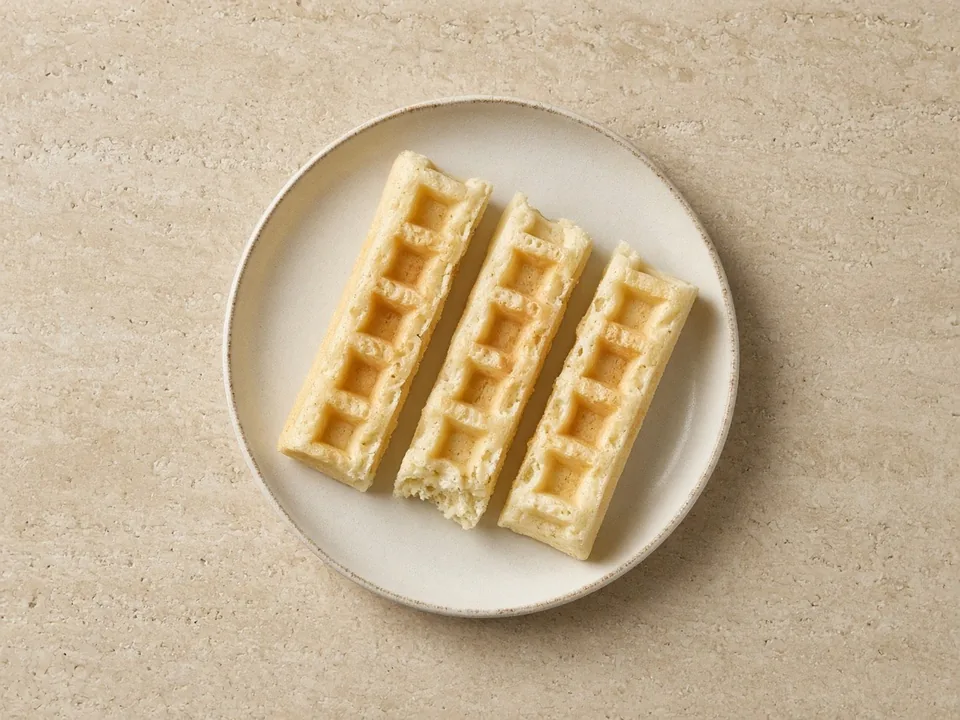
Soft waffle strips
Make plain waffles at home with no sugar or salt, cook them until set all the way through but still soft, and cut them into strips. Trim off any crisp or dark edges. Offer waffles once your baby has had egg, dairy (such as plain full-fat yogurt) and wheat on their own. No honey or syrup on top.
- Size
- Strips about the size of an adult finger, roughly 6–8 cm long and 2 cm wide (2½–3 × ¾ in).
- Check before serving
- Tear a strip open: there should be no wet batter inside. It should squash easily between your thumb and finger, with no crunchy edges.
US and UK advice differ here. The AAP suggests mashed food or soft pieces no larger than ½ inch; the NHS suggests soft finger-sized pieces your baby can hold in their fist. Both agree the food must squash easily.
9 months+
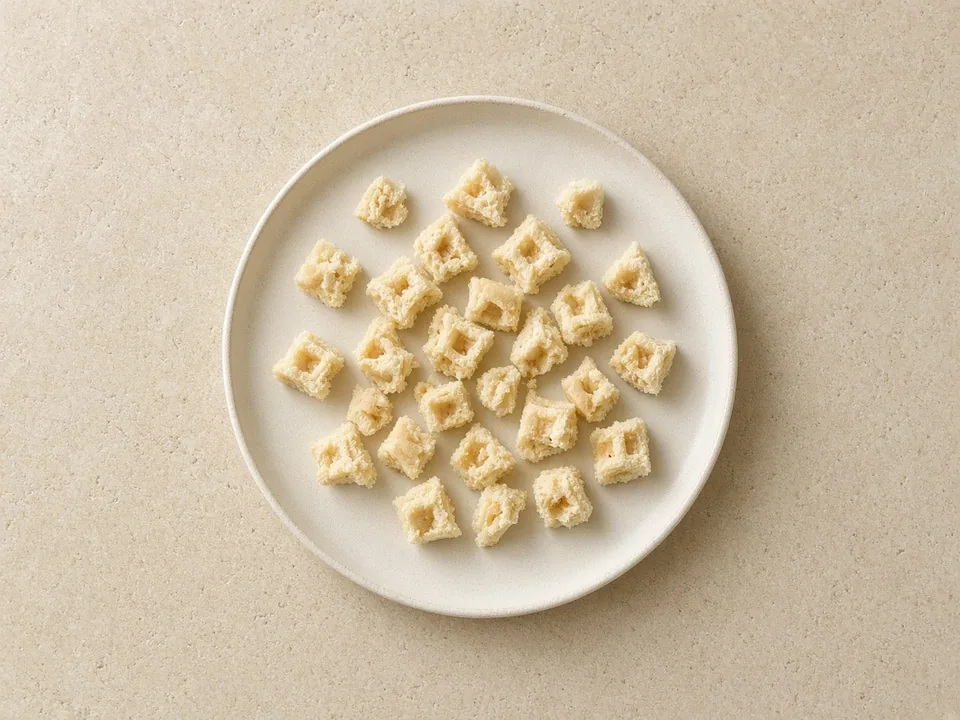
Small soft pieces or strips
Cut soft waffles into small pieces for pincer-grasp practice, or keep serving strips. Spread a thin layer of mashed fruit or plain, unsweetened yogurt into the squares.
- Size
- Pieces no bigger than about 1 cm (just under ½ inch).
- Check before serving
- Each piece should be cooked through and squash easily between your thumb and finger.
12 months+
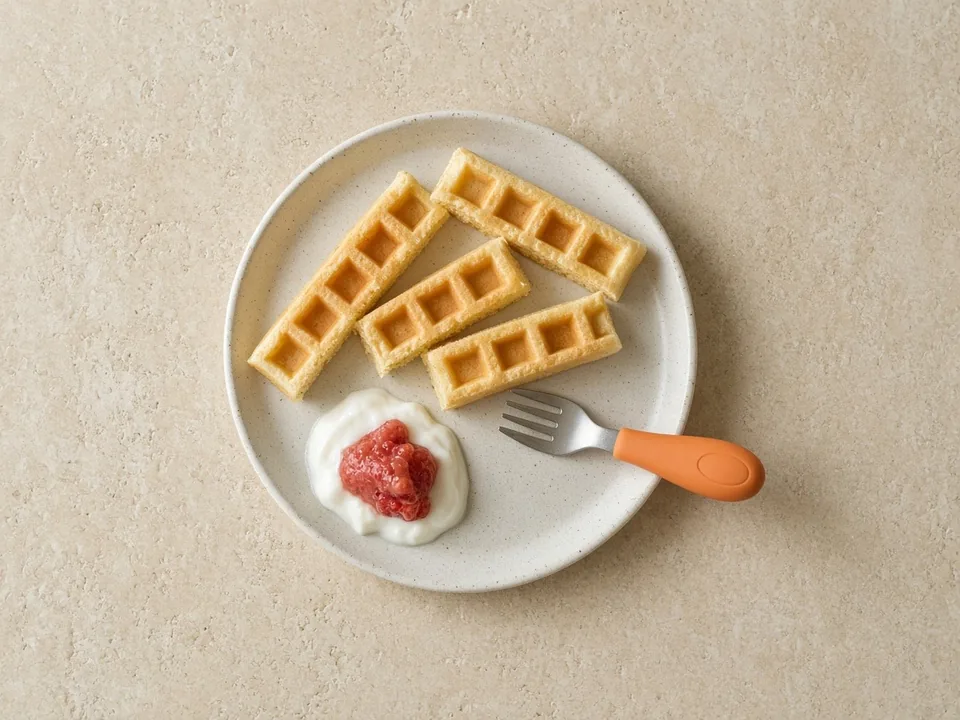
Strips or pieces with soft toppings
Serve waffles with plain yogurt, mashed fruit or a thin spread of smooth nut butter. Skip syrup, honey and sugar: honey is safe from 12 months, but it's an added sugar, and US and UK advice is to avoid added sugar up to age 4. Shop-bought frozen waffles are salty and often sweetened, so keep them occasional.
- Size
- Narrow strips, or bite-sized pieces about 1 cm (just under ½ inch).
- Check before serving
- Check the middle is cooked through and the edges aren't hard or crunchy.
18 months+
Family waffles, cut up
Offer the waffles your family eats, made without sugar, cut into strips or pieces and topped with fruit instead of syrup. Toasted frozen waffles can turn crisp, so cut them small and check they aren't hard. If you add blueberries, squash them flat or quarter them lengthwise first.
- Size
- Narrow strips, or bite-sized pieces about 1 cm (just under ½ inch).
- Check before serving
- Check for hard, crunchy edges and any round fruit before serving.
Always have your child sit upright in a high chair or at the table, and stay with them the whole time they eat. Keep to the size and texture for their stage. Every baby develops on their own timeline.
How to prepare waffles
- 1
Whisk flour, egg and milk into a smooth batter. Cows' milk is fine in cooking from around 6 months (see the US vs. UK note below). Leave out sugar and salt, use only as much baking powder as the recipe needs, and mash in a ripe banana if you'd like some sweetness.
- 2
Cook in a lightly oiled waffle iron until set all the way through, with no wet batter inside. Egg dishes should reach 160°F (71°C). Take them out while they're golden and soft rather than dark and crisp.
- 3
Let them cool, then cut them into strips or pieces for your baby's stage. Trim any crisp edges.
- 4
Offer waffles only once your baby has had egg, dairy (such as plain yogurt) and wheat on their own. First time? Pick a day your baby is well, at home, when you can watch them for a couple of hours afterward.
How much to offer
For the first taste, offer one or two strips. If there's no reaction, offer more next time. Your baby decides how much to eat: stop when they turn away or close their mouth. Once egg, milk and wheat are in your baby's diet, keep offering them regularly.
Common mistakes
Making waffles the first taste of egg, milk or wheat
Waffles contain three common allergens. Offer each on its own first, one at a time, so you know what caused any reaction: for milk, plain full-fat yogurt works well.
Adding syrup, honey or sugar
No honey before 12 months, because of the risk of infant botulism. Maple syrup isn't honey, so the botulism warning isn't about it, but it's still an added sugar. US and UK advice is to avoid added sugar, including honey and syrup, for children aged 4 and under. Top waffles with mashed fruit instead.
Serving crisp or toasted waffles to a young baby
The CDC advises avoiding hard foods that are difficult to chew and swallow. Keep waffles soft, trim crisp edges, and don't toast them until crunchy.
Using frozen waffles every day
Plain frozen waffles have about 638 mg of sodium per 100 g (about 1.6 g of salt), and the NHS says babies under 1 should have less than 1 g of salt a day. Many are sweetened too, so check the label. Make your baby's waffles at home.
Where US and UK guidance differ on waffles
United States(AAP and CDC)Your setting
Cook waffles until set all the way through, with no wet batter: USDA FSIS says dishes containing eggs should reach 160°F (71°C), and the CDC lists raw batter and undercooked egg as riskier choices for children under 5. The CDC says not to give cow's milk before 12 months. If you follow US advice, use breast milk or formula instead.
United Kingdom(NHS)Your setting
The NHS says hens' eggs with the British Lion stamp (a red lion) can be eaten lightly cooked; other hens' eggs, and duck, goose and quail eggs, should be cooked until the white and yolk are solid. For babies, we suggest cooking waffles until set all the way through, so they hold together as a soft strip. The NHS says cows' milk can be used in cooking or mixed with food from around 6 months, but shouldn't be given as a main drink until 1 year.
We cover US and UK guidance in detail. Elsewhere, check your national health service's advice too.
Questions parents ask
Can waffles be a choking hazard for babies?
Waffles are a medium choking risk. Soft homemade waffles are easy to manage, but crisp edges and toasted frozen waffles can be hard, and the CDC advises avoiding small, sticky or hard foods that are difficult to chew and swallow. Keep waffles soft, trim crisp edges, cut them into strips or small pieces, and squash any berries flat or quarter them lengthwise, since the CDC lists uncut berries as a choking hazard. Stay with your child during meals.
Can babies be allergic to waffles?
Waffles usually contain three common allergens: wheat (with gluten) in the flour, egg and cows' milk. Foods that can trigger allergy can be introduced from around 6 months. Introduce each one on its own first, one at a time and in small amounts, so you can spot a reaction. Most reactions start within a few minutes to 2 hours, but cows' milk allergy can take up to 3 days to show. Once your baby is fine with all three, waffles are an easy way to keep them in your baby's usual diet. Shop-bought waffles may contain other allergens, such as soy, so check the label.
Are waffles healthy for babies?
Plain waffles made from a standard recipe provide carbohydrate, some protein (about 7.9 g per 100 g) and calcium (about 255 mg per 100 g), with about 2.3 mg of iron per 100 g. They also have about 511 mg of sodium per 100 g (about 1.3 g of salt), so leave salt out of the batter. Plain frozen waffles have more iron (about 5.6 mg per 100 g) but also more salt (about 638 mg of sodium, or 1.6 g of salt) and about 4.9 g of sugars per 100 g.
When can babies eat waffles?
From around 6 months, once your baby has had egg, dairy (such as plain yogurt) and wheat on their own without a reaction. Make them at home without sugar or salt, cook them through but keep them soft, and cut them into finger-sized strips.
Can babies eat frozen toaster waffles?
It's best to make waffles at home for babies. Plain frozen waffles have about 638 mg of sodium (about 1.6 g of salt) per 100 g, and the NHS says babies under 1 should have less than 1 g of salt a day, and children aged 1 to 3 no more than 2 g. From 12 months they're fine now and then: warm them until soft rather than crisp, cut them small, and check the label for added sugar.
Can babies have syrup on waffles?
It's best not to. Honey isn't safe before 12 months because of infant botulism. Maple syrup and honey are both added sugars, and the US Dietary Guidelines and the NHS say to avoid added sugar for children aged 4 and under. Try mashed fruit or plain yogurt instead.
Can I freeze homemade waffles?
Yes. Freeze them in a single layer, then bag them, for 2 to 3 months. Reheat only once, until steaming hot, 165°F (74°C), then let them cool and check they're still soft before serving.
If your baby refuses waffles
- Many babies need 10 or more tries before they accept a new food. Keep offering it alongside foods they already like.
- Try another shape: strips, small pieces or mini waffles.
- Add a topping your baby already likes, such as mashed banana or plain yogurt.
- Eat some yourself at the same meal. Babies copy what they see.
Never force or pressure your baby to eat. Some days they'll eat more, some days less, and that's normal.
Buying and storing waffles
- Cook batter right away, or keep it in the fridge and cook it within 24 hours: it contains raw egg.
- Cooked waffles keep for 3 to 4 days in a covered container in the fridge.
- Cooked waffles can be frozen for 2 to 3 months. Reheat only once, to 165°F (74°C), until steaming hot, then let them cool before serving.
- Throw away any food left out at room temperature for more than 2 hours (1 hour if it's hotter than 90°F / 32°C).
When to talk to your doctor
Contact your pediatrician, GP or health visitor if:
- Your baby has had any reaction to egg, milk or wheat, even a mild one. Stop offering waffles until you've talked to your pediatrician.
- Your baby vomits a few hours after eating a food made with milk, such as waffles. This can be FPIES, a delayed type of food allergy that milk can trigger. If they vomited once or twice and seem alert and like themselves, call your pediatrician or GP. If they vomit again and again, or are pale, floppy, very sleepy or hard to wake, call your emergency number.
- You notice mild signs of an allergic reaction after eating, such as a few hives or a little vomiting. See signs of a reaction.
- You're worried about how much your baby eats, their growth, or they refuse most solid food for weeks.
Call 911999your local emergency number (such as 112 in Europe or 000 in Australia) now if your baby has trouble breathing, wheezing, can't cough or cry, has lips, mouth, tongue or throat that suddenly swell, or becomes pale, bluish, floppy or unresponsive. Also call if hives come with repeated vomiting.
Offered waffles?
Add it to your first 100 foods.
Waffles is in your 100 foods
1 of 100 offered · See all
Last offered today. Once waffles is in your baby's diet, keep offering it regularly.
Add a note (likes, dislikes, any reaction)
Saved in this browser only. Think it was a reaction? See signs of an allergic reaction and when to get help.
Helpful guides
Sources
- NHS: Food allergies in babies and young children
- NHS: Foods to avoid giving babies and young children
- NHS: Salt in your diet
- HHS: Fact sheet on the Dietary Guidelines for Americans, 2025–2030
- CDC: Choking hazards
- CDC: Cow's milk and milk alternatives
- CDC: Safer food choices for children under 5
- NHS: Your baby's first solid foods
- USDA FSIS: Shell eggs from farm to table
- ACAAI: Food protein-induced enterocolitis syndrome (FPIES)
- USDA FoodData Central: Waffles, plain, prepared from recipe
- USDA FoodData Central: Waffles, plain, frozen, ready-to-heat
- FoodSafety.gov: Cold food storage chart
- NHS Best Start in Life: Storing and reheating food
- USDA FSIS: Leftovers and food safety
More first foods





Free printable: The First 100 Foods checklist
Tick off foods as your baby tries them. Print it or save it as a PDF, no sign-up needed.