
Butternut squash soup
A smooth, mild soup of butternut squash, carrot and onion, cooked in water with no salt or stock. Blend it thick enough to load a spoon for your baby, and thin the rest for the family.
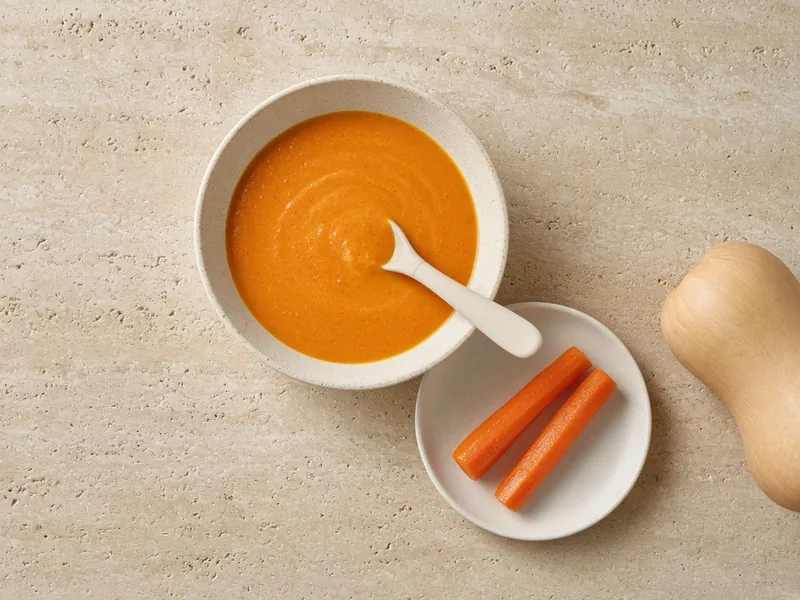
- From
- 6 months
- Time
- 45 min
- Makes
- 2 adults and 1 baby, with leftovers
No top allergensOptional extra contains milk
Ingredients
- 1 mediumbutternut squashabout 1 kg (2¼ lb)
- 2 mediumcarrots
- 1onionfinely chopped
- 1 clovegarlicfinely minced, optional
- ½ tspdried mixed herbs or thymeoptional, with no added salt
- 750 ml (3 cups)wateruse water, not ready-made stock, which is usually salty
- 1 tbspvegetable or olive oil
- 1–2 tspplain full-fat yogurtoptional, to swirl on top; pasteurized, with no added sugar. It contains milk: use it only once your baby has had dairy on its own
Steps
- 1Wash your hands. Scrub the squash with a clean vegetable brush under running water, then peel it, scoop out all the seeds and stringy bits, and cut it into cubes about 2 cm (¾ in). Scrub the carrots under running water and peel them. Cut one lengthwise into sticks about 6–8 cm long and 2 cm wide (2½–3 × ¾ in), never round coins, for your baby to dip, and chop the other. Rinse and peel the onion, then chop it finely.
- 2Heat the oil in a large pan over medium-low heat and cook the onion gently for about 10 minutes, stirring, until very soft and see-through. Add the garlic and herbs for the last minute, without letting them brown.
- 3Add the squash, chopped carrot, carrot sticks and water. Bring to a boil, then cover and simmer gently for 20 to 25 minutes, until the squash and carrot fall apart when you press them with a spoon. Don't add salt or stock. Before you blend, lift out the carrot sticks with a slotted spoon and squash one between your thumb and finger: it should flatten easily.
- 4Blend until smooth, or mash with a potato masher, leaving soft lumps, once your baby is used to eating. Take your baby's portion out now, before any extra water or seasoning goes in. It should be thick enough to stay on a spoon when you tip it; if it's runny, simmer it uncovered for a few minutes.
- 5Spread your baby's portion in a shallow bowl to cool, stirring. Soup holds heat, so stir it well and check the temperature before serving: it should feel only just warm, never hot. Swirl in the yogurt, if using.
How to serve it by age
6 months+
Serve the soup thick, on a pre-loaded spoon your baby can hold, or let them scoop it up with their fingers. Offer the soft carrot sticks you set aside to dip.
9 months+
Leave soft lumps, or stir in small pieces of soft-cooked squash no bigger than about 1 cm (just under ½ inch). Offer fingers of lightly toasted plain bread (no honey) to dip once wheat has been introduced.
12 months+
Serve the soup from the unsalted family pot in a bowl with a spoon, with toast fingers or soft bread on the side. Keep it warm, not hot.
Where US and UK guidance differ on this recipe
United States(AAP and CDC)Your setting
The AAP says fresh baby food should be cooked with no added salt or seasoning, and doesn't give an age for herbs or garlic. If you'd rather follow that closely, leave out the garlic and herbs, or ask your pediatrician.
United Kingdom(NHS)Your setting
The NHS says not to add salt, stock cubes or gravy to your baby's food or cooking water. Its baby recipes use garlic (a dhal for babies from 6 months) and mixed dried herbs (an autumn lentil soup with butternut squash for babies aged 7 to 9 months).
We cover US and UK guidance in detail. Elsewhere, check your national health service's advice too.
If your baby reacts
The optional extras contain milk. Introduce one new allergen at a time, mixed into a food your baby already eats, before serving it in a dish with other new foods. Contact your pediatrician, GP or health visitor if you notice mild signs after eating, such as a few hives or a little vomiting. See signs of a reaction.
Call 911999your local emergency number (such as 112 in Europe or 000 in Australia) now if your baby has trouble breathing, wheezing, can't cough or cry, has lips, mouth, tongue or throat that suddenly swell, or becomes pale, bluish, floppy or unresponsive. Also call if hives come with repeated vomiting.
Leftovers and the rest of the family
Storing it
Cool leftovers quickly in shallow containers and keep them covered in the fridge for 3 to 4 days, or freeze them in small portions for 2 to 3 months (before adding any yogurt). Reheat only the portion you need, and only once, until steaming hot, 165°F (74°C), or bring it to a rolling boil, stirring so there are no hot or cold spots. Let it cool and check the temperature before serving. Throw away anything left in your baby's bowl, and any soup left out at room temperature for more than 2 hours (1 hour if it's hotter than 90°F / 32°C).

For the grown-ups
Take your baby's portion out first, then thin the rest with a little water and season it with salt, black pepper and a pinch of chili or nutmeg for the adults. Serve with crusty bread.
Foods in this recipe







Free printable: The First 100 Foods checklist
Tick off foods as your baby tries them. Print it or save it as a PDF, no sign-up needed.
Sources
- NHS Best Start in Life: Autumn lentil soup
- NHS Best Start in Life: Delicious dhal
- NHS: Your baby's first solid foods
- NHS Best Start in Life: Storing and reheating food
- AAP: When can babies start solid foods?
- Food Standards Agency: Home food fact checker
- USDA FSIS: Leftovers and food safety
- USDA FSIS: Freezing and food safety
- NHS: Foods to avoid giving babies and young children