
Banana chia pudding
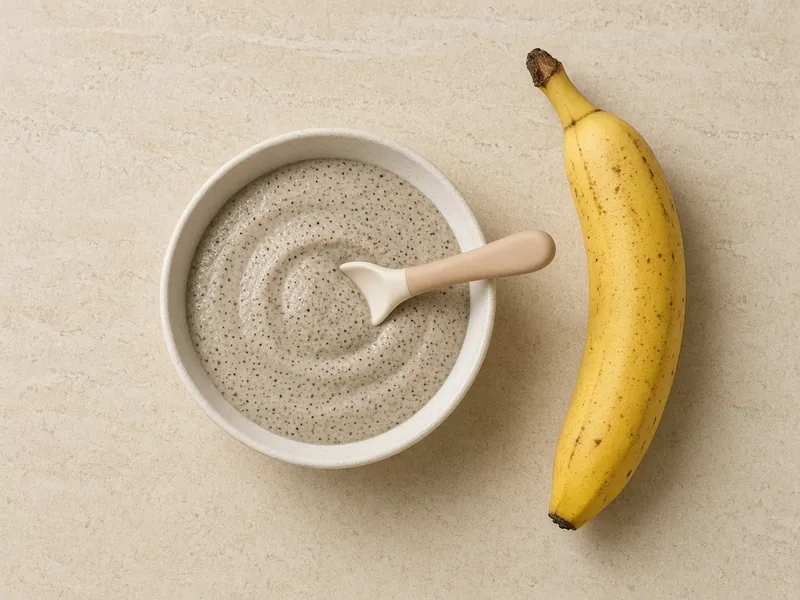
Ground chia soaked in breast milk or formula with mashed banana until fully set, soft and spoonable. No sugar or honey: the banana adds the sweetness. Always use ground chia, never dry or whole seeds.
- From
- 9 months
- Time
- 35 min
- Makes
- 1 baby portion
No top allergensOptional extra contains milk
Ingredients
- 2 tspground (milled) chia seedsor whole chia ground fine in a clean, dry spice grinder. If chia is new to your baby, make the pudding as written but offer only a spoonful or two the first time, and build up over a few days
- 4 tbsp (60 ml)breast milk or formulafrom 12 months, whole cow's milk or plain full-fat yogurt can be used instead. Offer it only once dairy has been introduced on its own
- ¼ripe bananayellow with brown speckles, so it mashes easily
Steps
- 1Wash your hands. Rinse the banana under running water, even though you'll peel it.
- 2Mash the banana in a small bowl until smooth. Stir in the breast milk or formula, then sprinkle in the ground chia and stir well. Don't add sugar, honey or syrup.
- 3Wait 5 minutes, then stir again to break up any clumps.
- 4Cover and put it in the fridge for at least 30 minutes, or overnight, until it's thick and set.
- 5Stir and check before serving: no dry powder, dry seeds or dry clumps should be left, and the pudding should be soft and smooth. If it's too thick to slide off a spoon, stir in a little more breast milk or formula.
How to serve it by age
9 months+
Offer on a pre-loaded spoon your baby can hold, or let them scoop it with their fingers. Offer sips of water from an open cup with the meal: the AAP says a little water is fine once solids start, up to 1 cup (8 oz) a day.
12 months+
Make it with whole milk or plain yogurt if you like, once dairy has been introduced. Top with fresh soft ripe mango or banana in pieces about 1 cm (just under ½ inch), or fresh berries (not thawed frozen ones) quartered or flattened. Each piece should squash easily between your thumb and finger.
18 months+
Serve in a bowl with a spoon, as breakfast or a snack. Keep using ground chia, fully soaked. Never sprinkle dry chia seeds on top or give them by the spoonful.
Where US and UK guidance differ on this recipe
United States(AAP and CDC)Your setting
The AAP lists nuts and seeds among foods to avoid under 1, because they can be a choking hazard. That's why this recipe uses only ground chia, fully soaked and set, never whole seeds.
United Kingdom(NHS)Your setting
The NHS says seeds can be introduced from around 6 months, like other foods that can trigger allergies, and to serve seeds finely ground.
We cover US and UK guidance in detail. Elsewhere, check your national health service's advice too.
If your baby reacts
The optional extras contain milk. Introduce one new allergen at a time, mixed into a food your baby already eats, before serving it in a dish with other new foods. Contact your pediatrician, GP or health visitor if you notice mild signs after eating, such as a few hives or a little vomiting. See signs of a reaction.
Call 911999your local emergency number (such as 112 in Europe or 000 in Australia) now if your baby has trouble breathing, wheezing, can't cough or cry, has lips, mouth, tongue or throat that suddenly swell, or becomes pale, bluish, floppy or unresponsive. Also call if hives come with repeated vomiting.
Leftovers and the rest of the family
Storing it
Made with breast milk or formula, keep the pudding covered in the fridge and use it within 24 hours: the CDC's limit for prepared formula kept in the fridge, and for thawed breast milk. Made with whole milk or yogurt (12 months+), it keeps for 3 to 4 days in a covered container in the fridge. Serve it cold; it doesn't need reheating. Throw away anything left in your baby's bowl. Don't leave it at room temperature for more than 2 hours, or 1 hour if it's hotter than 90°F (32°C).
For the grown-ups
For older children and adults, make a bigger batch with whole milk and ground chia. Until 12 months, make your baby's portion separately with breast milk or formula. Adults and children aged 4 and over can add honey or syrup to their own bowls.
Foods in this recipe

Free printable: The First 100 Foods checklist
Tick off foods as your baby tries them. Print it or save it as a PDF, no sign-up needed.
Sources
- CDC: Choking hazards
- NHS: Food allergies in babies and young children
- AAP: When can babies start solid foods?
- NHS: Foods to avoid giving babies and young children
- CDC: Infant formula preparation and storage
- CDC: Breast milk storage and preparation
- CDC: Cow's milk and milk alternatives
- FDA: 7 tips for cleaning fruits and vegetables
- USDA FSIS: Leftovers and food safety