
Rice congee
A soft, silky rice porridge simmered in plenty of water until the grains break down, with sweet potato cooked in and no salt. A gentle, mild dish that you can blend smooth at 6 months and serve thicker, with soft toppings, as your baby grows.
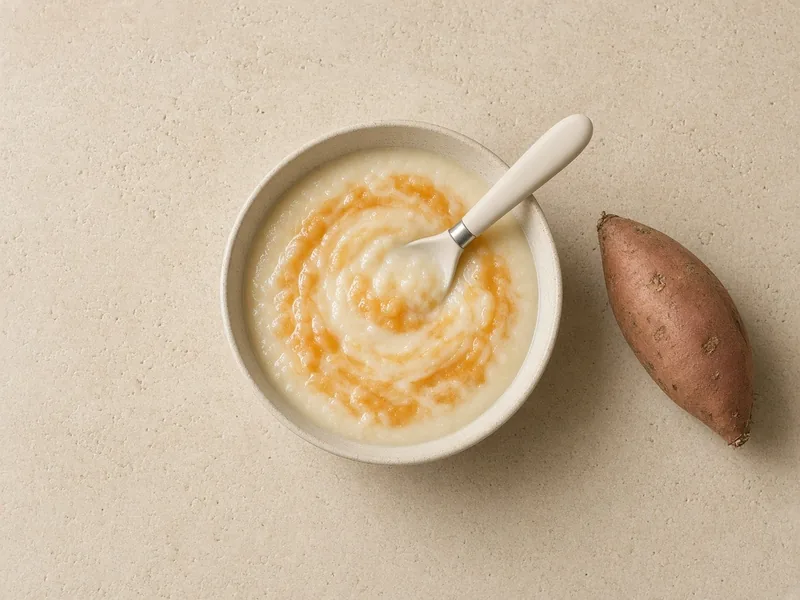
- From
- 6 months
- Time
- 80 min
- Makes
- 2 adults and 1 baby
No top allergensOptional extra contains egg
Ingredients
- 100 g (½ cup)white ricesuch as jasmine or another long-grain white rice
- 1.2 litres (5 cups)waterplus extra boiling water as needed; use water, not ready-made stock, which is usually salty
- 1 smallsweet potatoabout 200 g (7 oz)
- 1eggoptional, for an egg version. Use it only once your baby has had egg on its own
Steps
- 1Wash your hands. Scrub the sweet potato under running water, peel it and cut it into small cubes about 1 cm (just under ½ inch).
- 2Put the rice and water in a large pan and bring it to a boil, stirring so the rice doesn't stick. Partly cover and simmer very gently for 60 to 75 minutes, stirring now and then, and more often near the end, until the grains break down into a thick, silky porridge. Add a splash of boiling water if it gets too thick. Don't add salt or stock.
- 3Add the sweet potato for the last 20 minutes, until it squashes easily between your thumb and finger. If rice is new to your baby, scoop out a little plain congee first, before the sweet potato goes in.
- 4Take your baby's portion out now, before any egg, soy sauce or other seasoning goes in: this portion is egg-free. Mash the sweet potato into it. Spread it in a shallow bowl to cool, stir, and check it's only just warm before serving: congee holds heat.
- 5For the egg version, beat the egg, pour it slowly into the simmering congee while stirring, and keep simmering and stirring for 2 minutes more, until the egg is cooked into firm strands with no runny egg left. Wash your hands after handling raw egg. Give your baby the egg version only once they've had egg on its own, and cool their bowl the same way.
- 6Cool any leftovers quickly, ideally within 1 hour: spread them in shallow containers, then refrigerate them.
How to serve it by age
6 months+
If rice is new, offer a little plain congee on its own first, earlier in the day: rice can cause a delayed reaction (FPIES). If your baby vomits once or twice a few hours later and seems alert and like themselves, call your pediatrician or GP. If they vomit again and again, or are pale, floppy, very sleepy or hard to wake, call your emergency number. Blend or mash the congee and sweet potato until smooth, loosening it with a little water, breast milk or formula. Squash a little between your thumb and finger: it should mash flat, with no firm grains. Serve it on a pre-loaded spoon.
9 months+
Serve it thicker and unblended, with soft sweet potato pieces no bigger than about 1 cm (just under ½ inch). Once your baby has had egg on its own, try the egg version. Let them practice with a spoon.
12 months+
Serve congee from the family pot, topped with soft foods your child already eats, such as finely shredded cooked chicken or soft-cooked greens chopped to about 1 cm (just under ½ inch). Leave the adults' salty toppings out of your toddler's bowl.
Where US and UK guidance differ on this recipe
United States(AAP and CDC)Your setting
USDA FSIS gives 3 to 4 days in the fridge for cooked leftovers in general. For rice, we follow the stricter UK rule for everyone. The AAP suggests cooking rice in extra water and draining it to lower arsenic, but congee keeps its cooking water, so that doesn't apply here. The AAP also suggests switching up grains, such as oats, barley and quinoa, so make rice one of several grains your baby eats. The CDC advises mashing cooked grains for babies, which is why congee is blended at first.
United Kingdom(NHS)Your setting
The Food Standards Agency says to cool rice quickly, ideally within 1 hour, keep it in the fridge for no more than 1 day, and never reheat it more than once. The NHS lists cooked rice among first finger foods and says not to add salt, stock cubes or gravy to your baby's food.
We cover US and UK guidance in detail. Elsewhere, check your national health service's advice too.
If your baby reacts
The optional extras contain egg. Introduce one new allergen at a time, mixed into a food your baby already eats, before serving it in a dish with other new foods. Contact your pediatrician, GP or health visitor if you notice mild signs after eating, such as a few hives or a little vomiting. See signs of a reaction.
Call 911999your local emergency number (such as 112 in Europe or 000 in Australia) now if your baby has trouble breathing, wheezing, can't cough or cry, has lips, mouth, tongue or throat that suddenly swell, or becomes pale, bluish, floppy or unresponsive. Also call if hives come with repeated vomiting.
Leftovers and the rest of the family
Storing it
Rice needs extra care. Cool leftovers quickly, ideally within 1 hour, keep them covered in the fridge for no more than 1 day, and reheat them only once. Or freeze small portions within 1 hour of cooking and use them within 2 to 3 months; thaw them in the fridge, eat them within 24 hours of thawing and reheat them only once. Congee thickens as it cools, so stir in a little water, then reheat only once, until steaming hot, 165°F (74°C), or bring it back to the boil, and let it cool before serving. Throw away anything left in your baby's bowl. Don't leave congee at room temperature for more than 2 hours, or 1 hour if it's hotter than 90°F (32°C).

For the grown-ups
Take your baby's portion out first, then top the adults' bowls with reduced-salt soy sauce, sliced scallions, shredded ginger, a few drops of sesame oil or chili.
Foods in this recipe



Free printable: The First 100 Foods checklist
Tick off foods as your baby tries them. Print it or save it as a PDF, no sign-up needed.
Sources
- Food Standards Agency: Home food fact checker
- AAP: Heavy metals in baby food
- CDC: When, what, and how to introduce solid foods
- ACAAI: Food protein-induced enterocolitis syndrome (FPIES)
- CDC: Safer food choices for children under 5
- NHS: Your baby's first solid foods
- USDA FSIS: Leftovers and food safety
- USDA FSIS: Freezing and food safety
- NHS Best Start in Life: Storing and reheating food