
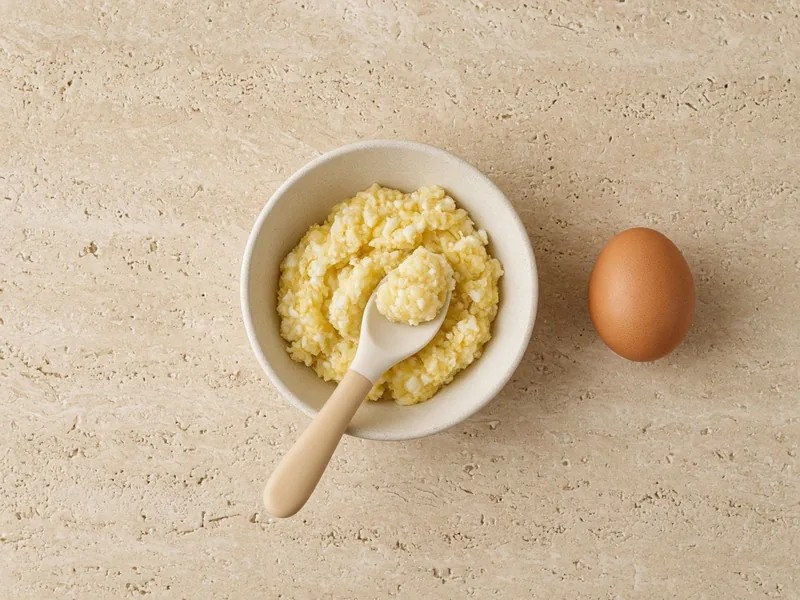
Well-cooked egg mash (yolk and white)
A hard-boiled egg, cooked until the yolk and white are firm, mashed smooth with a little breast milk or formula. Mash the yolk and white together: the goal is to introduce the whole egg, and egg white is the more common cause of egg allergy. Egg is the only new food here. Once your baby has had egg without a reaction, keep it in their diet regularly.
- From
- 6 months
- Time
- 20 min
- Makes
- 1 egg (2–3 baby portions)
Contains egg
Ingredients
- 1egg
- 1–3 tspbreast milk, formula or waterto make it smooth and moist
Steps
- 1Wash your hands. Put the egg in a small pan and cover it with cold water.
- 2Bring the water to the boil, then turn it down and simmer for about 10 to 12 minutes, until the egg is hard-boiled.
- 3Lift the egg into a bowl of cold water to cool, then peel it. Cut it in half: the yolk and the white should both be firm all the way through, with no soft or runny yolk. If any part is soft, simmer the halves a little longer.
- 4Cut off the portion you're serving now, with both yolk and white in it, and keep the rest of the egg covered in the fridge for next time. Mash the yolk and white together with a fork. Stir in breast milk, formula or water a little at a time until it's smooth and moist, not dry or crumbly. Don't add salt.
How to serve it by age
6 months+
Pick a day your baby is well, at home, when you can watch them for a couple of hours afterward. Start small: a teaspoon of mash on a pre-loaded spoon, or stirred into mashed avocado or sweet potato your baby already eats. If there's no reaction, offer more next time.
9 months+
Mash it more roughly, or chop the egg into pieces no bigger than about 1 cm (just under ½ inch) for pincer-grasp practice. Moisten crumbly yolk with a little breast milk or formula.
12 months+
Serve chopped egg in pieces about 1 cm (just under ½ inch), or spread mashed egg on toast fingers once wheat has been introduced. Don't serve hard-boiled egg in round slices.
Where US and UK guidance differ on this recipe
United States(AAP and CDC)Your setting
Cook eggs until the white and yolk are firm. The AAP says to talk to your pediatrician first if your baby has severe, persistent eczema or has had an allergic reaction to a food, to plan how and when to introduce egg.
United Kingdom(NHS)Your setting
The NHS says hens' eggs with the British Lion stamp can be lightly cooked, but this recipe is the same everywhere: cooked until firm. Talk to your GP or health visitor first if your baby has eczema or a food allergy, or there's a family history of food allergies, eczema, asthma or hay fever.
We cover US and UK guidance in detail. Elsewhere, check your national health service's advice too.
If your baby reacts
This recipe contains egg. Introduce one new allergen at a time, mixed into a food your baby already eats, before serving it in a dish with other new foods. Contact your pediatrician, GP or health visitor if you notice mild signs after eating, such as a few hives or a little vomiting. See signs of a reaction.
Call 911999your local emergency number (such as 112 in Europe or 000 in Australia) now if your baby has trouble breathing, wheezing, can't cough or cry, has lips, mouth, tongue or throat that suddenly swell, or becomes pale, bluish, floppy or unresponsive. Also call if hives come with repeated vomiting.
Leftovers and the rest of the family
Storing it
Mash only the portion you're serving, just before the meal. Hard-boiled eggs should go in the fridge within 2 hours of cooking and be eaten within 1 week; keep the unmashed rest of the egg covered in the fridge and mash it fresh next time. Hard-boiled eggs don't freeze well, so don't freeze the mash. Serve it cold from the fridge or at room temperature. Throw away anything left in your baby's bowl. Don't leave egg at room temperature for more than 2 hours, or 1 hour if it's hotter than 90°F (32°C).

For the grown-ups
Boil a few eggs at once: mash one for your baby, and chop the rest into an egg salad or onto toast for the adults, seasoned after your baby's portion is taken out.
Foods in this recipe

Free printable: The First 100 Foods checklist
Tick off foods as your baby tries them. Print it or save it as a PDF, no sign-up needed.
Sources
- USDA FSIS: Shell eggs from farm to table
- Royal Devon University Healthcare NHS Trust: Home food introduction for foods such as eggs and milk
- ACAAI: Egg allergy
- AAP: When to introduce egg, peanut butter and other common food allergens
- NHS: Food allergies in babies and young children
- NHS: Foods to avoid giving babies and young children
- USDA FSIS: Leftovers and food safety