
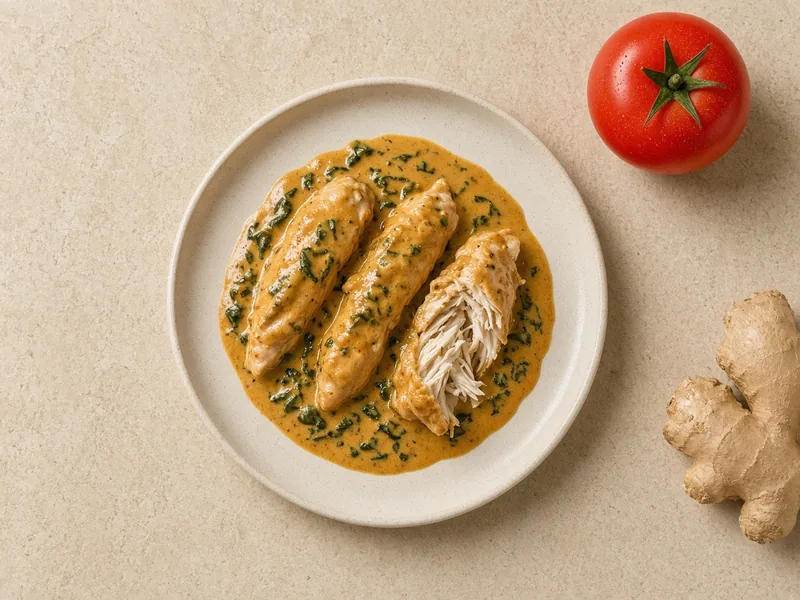
Mild chicken curry
A gentle family curry of tender chicken thighs simmered with tomato, a little coconut milk and mild spices, with no chili, salt or curry paste. If coconut is new, offer a little on its own first.
- From
- 6 months
- Time
- 60 min
- Makes
- 2 adults and 1 baby, with leftovers
No top allergens
Ingredients
- 4boneless, skinless chicken thighsabout 400 g (14 oz)
- 1onionfinely chopped
- 1 can (400 g / 14 oz)chopped tomatoesno salt added
- 150 ml (⅔ cup)canned coconut milkunsweetened, with no added sugar; not sweetened cream of coconut. If your child has a tree nut allergy, ask your allergist before offering coconut
- 150 ml (⅔ cup)water
- ½ tspground turmericoptional
- ½ tspground cuminoptional
- ½ tspground corianderoptional
- 1 clovegarlicfinely minced, optional
- 1 tspgrated fresh gingeroptional
- 2 handfuls (60 g / 2 oz)spinachoptional
- 1 tbspvegetable oil
- 200 g (1 cup)white riceoptional, to serve; see the storage note, because cooked rice needs extra care
Steps
- 1Wash your hands. Rinse and peel the onion, then chop it finely. If you use fresh ginger, rinse it, peel it and grate it very finely, throwing away any stringy bits. Rinse the spinach, remove any thick stems and chop the leaves very finely.
- 2Don't rinse the raw chicken: washing spreads bacteria around the kitchen. Wash your hands, board and knife after handling it.
- 3Heat the oil in a large pan over medium-low heat and cook the onion gently for about 10 minutes, stirring, until very soft and see-through. Add the garlic, ginger and spices and stir for 1 minute, without letting them brown.
- 4Add the whole chicken thighs, tomatoes and water. Bring to a boil, then cover and simmer gently for 30 to 35 minutes, until the chicken is very tender and reaches 165°F (74°C) in the thickest part. Check with a food thermometer: color isn't a reliable sign. Don't add salt, stock, chili or curry paste.
- 5Lift out the chicken, let it cool a little, then shred it finely or pull it into strips along the grain, removing any fat or gristle. Return it to the pan with the coconut milk and spinach and simmer for 3 minutes, until it just bubbles and the spinach is very soft. Move any leftover coconut milk out of the can into a covered container in the fridge.
- 6If you're serving rice, rinse it and cook it in plenty of unsalted water until very soft, then drain. Cool any leftover rice quickly and put it in the fridge within 1 hour.
- 7Take your baby's portion out now, before any salt, chili or other seasoning goes in. Mash it to a texture your baby can manage. Spread it in a shallow bowl to cool, stirring, and check it's only just warm before serving.
How to serve it by age
6 months+
Mash the sauce with finely shredded chicken into a thick, lumpy mash, on its own or stirred into very soft mashed rice with no firm grains, and serve it on a pre-loaded spoon. Or offer soft chicken strips about the size of an adult finger, roughly 6–8 cm long and 2 cm wide (2½–3 × ¾ in), that fall apart when you squash them between your thumb and finger, with the sauce as a dip.
9 months+
Chop the chicken into pieces no bigger than about 1 cm (just under ½ inch) and stir soft rice into the sauce so the grains stay moist, not loose and dry.
12 months+
Serve the curry from the unsalted pot with the family, with the chicken in bite-sized pieces about 1 cm (just under ½ inch), with soft rice, or flatbread once wheat has been introduced.
Where US and UK guidance differ on this recipe
United States(AAP and CDC)Your setting
The AAP says fresh baby food should be cooked with no added salt or seasoning, and doesn't give an age for spices or garlic. If you'd rather follow that closely, cook your baby's portion without the garlic, ginger and spices, or ask your pediatrician. Cook chicken to 165°F (74°C), checked with a food thermometer: the USDA says safely cooked chicken can still look pink. Coconut is no longer one of the major food allergens on US labels (FDA, 2025), but it must still appear in the ingredient list.
United Kingdom(NHS)Your setting
The NHS says not to add salt, stock cubes or gravy to your baby's food or cooking water. Its lamb curry recipe for babies aged 7 to 9 months uses garlic, ground cumin and ground coriander. The Food Standards Agency says to cool rice quickly, keep it in the fridge for no more than 1 day, eat thawed rice within 24 hours, and never reheat it more than once.
We cover US and UK guidance in detail. Elsewhere, check your national health service's advice too.
Leftovers and the rest of the family
Storing it
Cool the curry quickly in shallow containers and keep it covered in the fridge for 3 to 4 days, or freeze it in small portions for 2 to 3 months (coconut milk can separate after thawing: stir it well). Cooked rice needs extra care: cool it within 1 hour and keep it in the fridge for no more than 1 day, or freeze it within 1 hour of cooking. Thaw frozen rice in the fridge and eat it within 24 hours of thawing. Reheat rice only once, until steaming hot. Store rice and curry separately: once rice is mixed in, the rice rules apply to the whole dish. Reheat only the portion you need, and only once, until steaming hot, 165°F (74°C), stirring so there are no cold spots, then let it cool before serving. Throw away anything left in your baby's bowl. Don't leave it at room temperature for more than 2 hours, or 1 hour if it's hotter than 90°F (32°C).

For the grown-ups
Take your baby's portion out first, then season the rest with salt, chili and a squeeze of lime for the adults. Top with chopped cilantro (coriander) and serve with rice or flatbread.
Foods in this recipe












Free printable: The First 100 Foods checklist
Tick off foods as your baby tries them. Print it or save it as a PDF, no sign-up needed.
Sources
- USDA FSIS: Chicken from farm to table
- AAP: When can babies start solid foods?
- NHS: Your baby's first solid foods
- ACAAI: Tree nut allergy
- NHS Best Start in Life: Lamb curry
- FDA: Frequently asked questions, food allergen labeling guidance for industry
- Food Standards Agency: Home food fact checker
- USDA FSIS: Leftovers and food safety
- USDA FSIS: Freezing and food safety