
Pea risotto
A soft, creamy risotto of rice and peas cooked in water, not stock, with just a little grated cheese and no added salt. Contains milk: offer it once your baby has had dairy on its own. Mash it for first tastes.
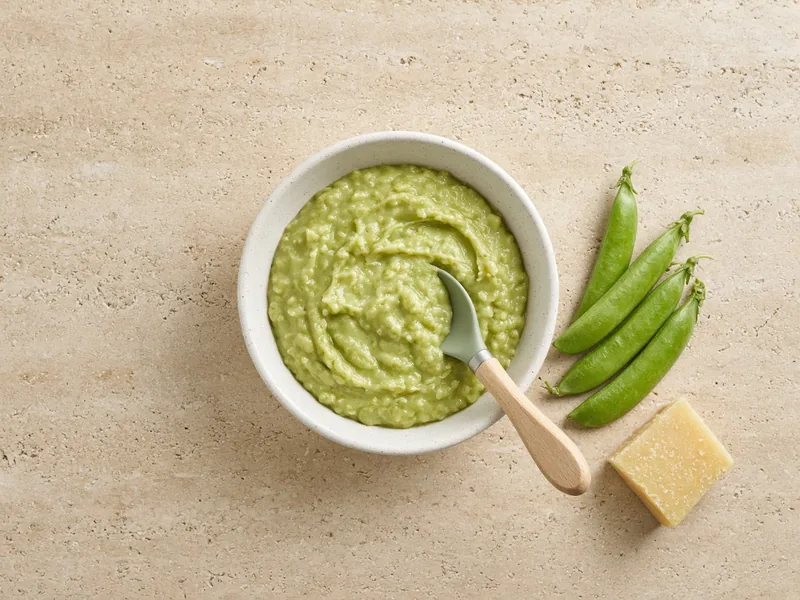
- From
- 6 months
- Time
- 40 min
- Makes
- 2 adults and 1 baby
Contains milk
Ingredients
- 1 tbspolive oil
- 1onionfinely chopped
- 200 g (1 cup)risotto ricesuch as arborio, or another short-grain white rice
- about 1 litre (4 cups)hot wateruse water, not ready-made stock, which is usually salty
- 200 g (1⅓ cups)frozen peas
- 20 g (¼ cup)finely grated hard cheesepasteurized. Parmesan is salty (about 1,180 mg of sodium per 100 g), so use only this small amount, or a lower-salt mild cheddar
Steps
- 1Wash your hands. Rinse and peel the onion, then chop it finely. Check the cheese label says it's made from pasteurized milk, then grate it finely.
- 2Heat the oil in a wide pan over medium-low heat and cook the onion gently for about 10 minutes, stirring, until very soft and see-through. Add the rice and stir for 1 minute, until every grain is coated in oil.
- 3Add a ladle of hot water and stir until it's mostly absorbed. Keep adding water a ladle at a time, stirring often, for 20 to 25 minutes, until the rice is very soft, a little past how adults like it, and the risotto is loose and creamy. Add more water if it gets thick. Don't add salt or stock.
- 4Meanwhile, cook the peas in a small pan of unsalted water for about 5 minutes, until very soft, then drain them and stir them into the risotto for the last 2 minutes.
- 5Take the pan off the heat and stir in the cheese until it melts.
- 6Take your baby's portion out now, before any seasoning or extra cheese goes in. Mash it, or press every pea in it flat with a fork. Spread it in a shallow bowl to cool, stir, and check it's only just warm before serving: risotto holds heat.
- 7Cool any leftovers quickly, ideally within 1 hour: spread them in a shallow container, then refrigerate them.
How to serve it by age
6 months+
Once your baby has had dairy on its own without a reaction, mash the risotto with a fork, or blend it briefly, until it's thick with soft lumps, no firm grains and every pea squashed. Loosen it with a little water, breast milk or formula, and serve it on a pre-loaded spoon or let your baby scoop it up with their fingers.
9 months+
Serve it soft and moist rather than mashed, with each pea pressed flat. Moist risotto sticks together, so it's easier to scoop or pick up than loose rice. Each grain should squash flat between your thumb and finger.
12 months+
Serve the family risotto from the unsalted pot, with the peas still squashed until your child chews well. Keep the cheese to a sprinkle rather than a handful: cheese is one of the salty foods to give in small amounts.
Where US and UK guidance differ on this recipe
United States(AAP and CDC)Your setting
USDA FSIS gives 3 to 4 days in the fridge for cooked leftovers in general. For rice, we follow the stricter UK rule for everyone. FDA research found that cooking rice in plenty of water and draining it lowers arsenic, but risotto rice soaks up its cooking water, so that doesn't work here. The AAP suggests switching up grains, so make risotto one of several grains your baby eats.
United Kingdom(NHS)Your setting
The Food Standards Agency says to cool rice quickly, ideally within 1 hour, keep it in the fridge for no more than 1 day, and never reheat it more than once. The NHS fish risotto with peas recipe for babies aged 7 to 9 months cooks the rice in water, and the NHS says not to add salt, stock cubes or gravy to your baby's food.
We cover US and UK guidance in detail. Elsewhere, check your national health service's advice too.
If your baby reacts
This recipe contains milk. Introduce one new allergen at a time, mixed into a food your baby already eats, before serving it in a dish with other new foods. Contact your pediatrician, GP or health visitor if you notice mild signs after eating, such as a few hives or a little vomiting. See signs of a reaction.
Call 911999your local emergency number (such as 112 in Europe or 000 in Australia) now if your baby has trouble breathing, wheezing, can't cough or cry, has lips, mouth, tongue or throat that suddenly swell, or becomes pale, bluish, floppy or unresponsive. Also call if hives come with repeated vomiting.
Leftovers and the rest of the family
Storing it
Rice needs extra care. Cool leftovers quickly, ideally within 1 hour, keep them covered in the fridge for no more than 1 day, and reheat them only once. Or freeze them within 1 hour of cooking and use them within 3 to 4 months; thaw them in the fridge, eat them within 24 hours of thawing and reheat them only once. Reheat only once, until steaming hot, 165°F (74°C), stirring in a splash of water, then let it cool before serving. Throw away anything left in your baby's bowl. Don't leave risotto at room temperature for more than 2 hours, or 1 hour if it's hotter than 90°F (32°C).

For the grown-ups
Take your baby's portion out first, then stir extra parmesan, black pepper, lemon zest and a little salt into the rest for the adults.
Foods in this recipe







Free printable: The First 100 Foods checklist
Tick off foods as your baby tries them. Print it or save it as a PDF, no sign-up needed.
Sources
- NHS Best Start in Life: Fish risotto with peas
- NHS: Your baby's first solid foods
- NHS: Salt in your diet
- USDA FoodData Central: Cheese, parmesan, hard
- USDA FSIS: Leftovers and food safety
- Food Standards Agency: Home food fact checker
- FDA: What you can do to limit exposure to arsenic
- AAP: Heavy metals in baby food
- NHS Best Start in Life: Storing and reheating food