
Quinoa banana porridge
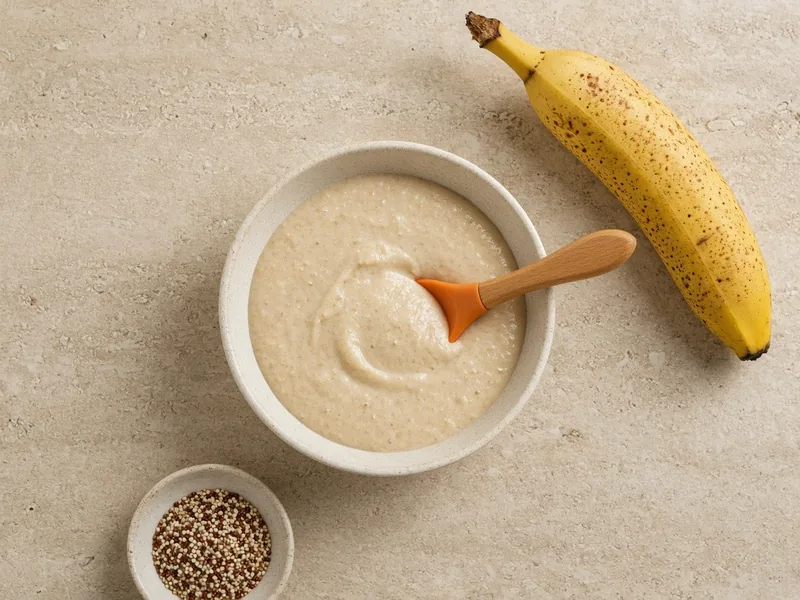
Rinsed quinoa simmered until very soft, then mashed with ripe banana for sweetness, with no added sugar. Smooth for first tastes, lumpier as your baby grows.
- From
- 6 months
- Time
- 30 min
- Makes
- 1 adult and 1 baby
No top allergensOptional extra contains milk
Ingredients
- 50 g (¼ cup)quinoaplain and uncooked
- 350 ml (1½ cups)waterfrom 12 months, you can use whole cow's milk for some of it. Offer it only once dairy has been introduced on its own
- ½ripe bananayellow with brown speckles, so it mashes easily
- 1–2 tbspbreast milk or formulaoptional, to loosen your baby's portion just before serving
Steps
- 1Wash your hands. Put the quinoa in a fine sieve and rinse it under cold running water for about a minute, rubbing the grains between your fingers, until the water runs clear. This washes off saponins, natural compounds on the outside of the seeds that taste bitter. Rinse it even if the pack says it's pre-washed.
- 2Put the quinoa and water in a small pan and bring to a boil. Lower the heat, cover and simmer for about 20 to 25 minutes, stirring now and then, a little longer than the package says, until the grains are very soft and have split open. Add a splash of water if it gets dry. Don't add salt, sugar, honey or syrup.
- 3Rinse the banana under running water, even though you'll peel it. Peel it and mash it smooth with a fork.
- 4Take your baby's portion out and stir in some of the banana. At 6 months, blend or mash it until smooth, with no firm grains left. From 9 months, you can mash it lightly instead, as long as each grain squashes flat. If it's too thick, loosen it with breast milk or formula just before serving. Keep any quinoa you're saving plain, without banana, breast milk or formula.
- 5Let it cool, stir well to get rid of hot spots, and check the temperature before serving. Press a little between your thumb and finger: it should mash flat, with no firm grains.
How to serve it by age
6 months+
Serve smooth and thick on a pre-loaded spoon your baby can hold, or let them scoop it with their fingers.
9 months+
Serve it thicker and lightly mashed, kept moist so the grains stick together. Each grain should squash flat between your thumb and finger, and any fruit stirred in should be in soft pieces no bigger than about 1 cm (just under ½ inch), with blueberries and other small round fruit squashed flat or quartered.
12 months+
Share the family pot, cooked with water or some whole milk (once dairy has been introduced on its own). Top it with soft fruit in pieces about 1 cm (just under ½ inch), and quarter or flatten blueberries and other small round fruit. Keep it soft and moist rather than dry and loose.
If your baby reacts
The optional extras contain milk. Introduce one new allergen at a time, mixed into a food your baby already eats, before serving it in a dish with other new foods. Contact your pediatrician, GP or health visitor if you notice mild signs after eating, such as a few hives or a little vomiting. See signs of a reaction.
Call 911999your local emergency number (such as 112 in Europe or 000 in Australia) now if your baby has trouble breathing, wheezing, can't cough or cry, has lips, mouth, tongue or throat that suddenly swell, or becomes pale, bluish, floppy or unresponsive. Also call if hives come with repeated vomiting.
Leftovers and the rest of the family
Storing it
Cool any plain cooked quinoa you're saving within 1 hour, then keep it in a covered container in the fridge for 3 to 4 days, or freeze small portions and use them within 3 months. Thaw it in the fridge and use it within 24 hours of thawing. Reheat only once, until steaming hot, 165°F (74°C), stir well and add a splash of water if it has thickened, then let it cool and stir in freshly mashed banana before serving. Throw away anything left in your baby's bowl. Don't leave porridge at room temperature for more than 2 hours, or 1 hour if it's hotter than 90°F (32°C).

For the grown-ups
Double the quinoa and water for a family pot and take the baby's portion out first. Adults and children aged 4 and over can stir chopped nuts into their own bowls: the CDC lists whole or chopped nuts as a choking hazard for young children. Honey waits until after age 4, because the NHS says children aged 4 and under should avoid sugar, including honey.
Foods in this recipe


Free printable: The First 100 Foods checklist
Tick off foods as your baby tries them. Print it or save it as a PDF, no sign-up needed.
Sources
- Int J Mol Sci: Quinoa saponins and their pharmaceutical potential, a review (2026)
- CDC: When, what, and how to introduce solid foods
- CDC: Choking hazards
- NHS: Your baby's first solid foods
- NHS: Foods to avoid giving babies and young children
- NHS: Starchy foods and carbohydrates
- FDA: 7 tips for cleaning fruits and vegetables
- USDA FSIS: Leftovers and food safety
- NHS Best Start in Life: Storing and reheating food