
Roasted carrot sticks
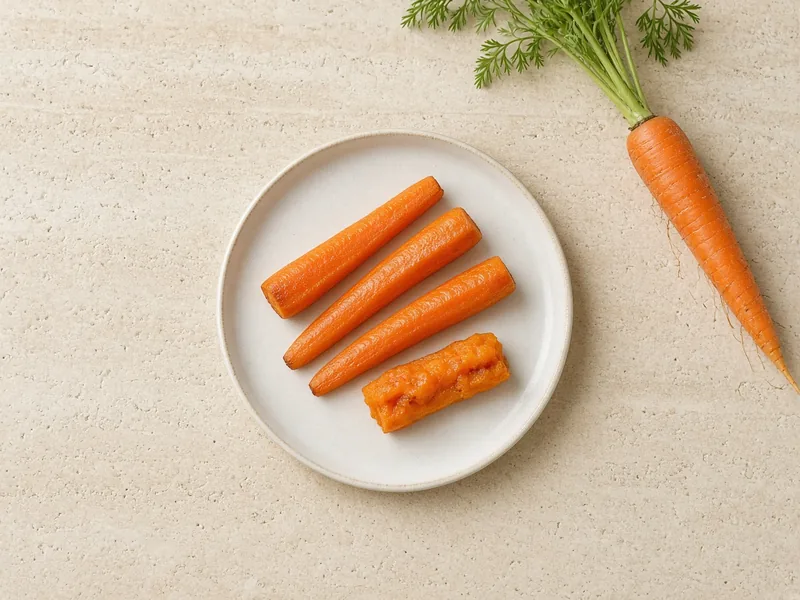
Soft oven-roasted carrot sticks with no salt, covered for the first part of cooking so they turn tender all the way through. An easy finger food your baby can hold, and a side for the whole family.
- From
- 6 months
- Time
- 45 min
- Makes
- 2 adults and 1 baby
No top allergens
Ingredients
- 4 mediumcarrotsabout 400 g (14 oz) in total
- 1 tbspvegetable or olive oil
- 3 tbspwater
Steps
- 1Wash your hands. Heat the oven to 200°C (400°F). Scrub the carrots with a clean vegetable brush under running water, then peel them and trim both ends.
- 2Cut each carrot in half across, then lengthwise into sticks about the size of an adult finger, roughly 6–8 cm long and 2 cm wide (2½–3 × ¾ in). Cut the thick top end into quarters so all the sticks are the same size. Never cut carrot into round coins.
- 3Toss the sticks in the oil and spread them out in a single layer in a roasting tin. Add the water and cover the tin tightly with foil, so the carrots steam and soften first. Don't add salt.
- 4Roast for 20 minutes, then take off the foil, turn the sticks and roast for another 15 to 20 minutes, until a knife slides through the thickest stick with no resistance.
- 5Squash a stick from the thickest part between your thumb and finger. It should flatten easily all the way through. Roasted carrot can stay firm in the middle, so if you have to press hard, cover it again and roast a little longer. Trim off any crisp or dark brown ends from your baby's sticks.
- 6Let them cool, dab off any extra oil with kitchen paper, and check they're only just warm before serving.
How to serve it by age
6 months+
Offer one or two whole soft sticks, about the size of an adult finger, so your baby can hold one in their fist with a bit sticking out. Or mash a stick and serve it on a pre-loaded spoon. Raw carrot is a choking hazard: only offer carrot cooked until it squashes easily.
9 months+
Cut soft sticks into pieces no bigger than about 1 cm (just under ½ inch), not round coins, for pincer-grasp practice. Or keep offering whole soft sticks to bite.
12 months+
Serve sticks or bite-sized pieces about 1 cm (just under ½ inch) with family meals, such as fish, beans or eggs. Keep doing the squash test. This recipe stays with soft roasted carrot; US and UK advice differs on raw carrot for toddlers (see the US and UK note below).
Where US and UK guidance differ on this recipe
United States(AAP and CDC)Your setting
Keep serving carrot cooked soft. The CDC lists pieces of hard raw vegetables, such as raw carrots, as a choking hazard for young children.
United Kingdom(NHS)Your setting
Cook carrot until soft in the first year: the NHS says to avoid raw carrot for babies. From 12 months, its snack ideas include cooked or raw vegetables such as carrot sticks. If you offer raw carrot, grate it finely, and stay with your child.
We cover US and UK guidance in detail. Elsewhere, check your national health service's advice too.
Leftovers and the rest of the family
Storing it
Cool leftover carrot sticks quickly and keep them in a covered container in the fridge for 3 to 4 days, or freeze them for 3 to 4 months (freeze them in a single layer, then pack them together once frozen). Reheat only once, until steaming hot, 165°F (74°C), then let them cool before serving. Throw away anything left in your baby's bowl. Don't leave carrot sticks at room temperature for more than 2 hours, or 1 hour if it's hotter than 90°F (32°C).

For the grown-ups
Roast a full tin and take your baby's sticks out first, then toss the rest with salt, black pepper or ground cumin for the adults.
Foods in this recipe

Free printable: The First 100 Foods checklist
Tick off foods as your baby tries them. Print it or save it as a PDF, no sign-up needed.