
Spinach pesto pasta
Soft pasta stirred through a smooth, unsalted pesto of wilted spinach, basil, olive oil and a little parmesan, made nut-free or with finely ground pine nuts. Like pesto, it's from 12 months: offer it once your child has had wheat and dairy, and any nuts you use, each on their own. Before 12 months, offer the parts separately, such as finely chopped cooked spinach stirred into soft pasta.
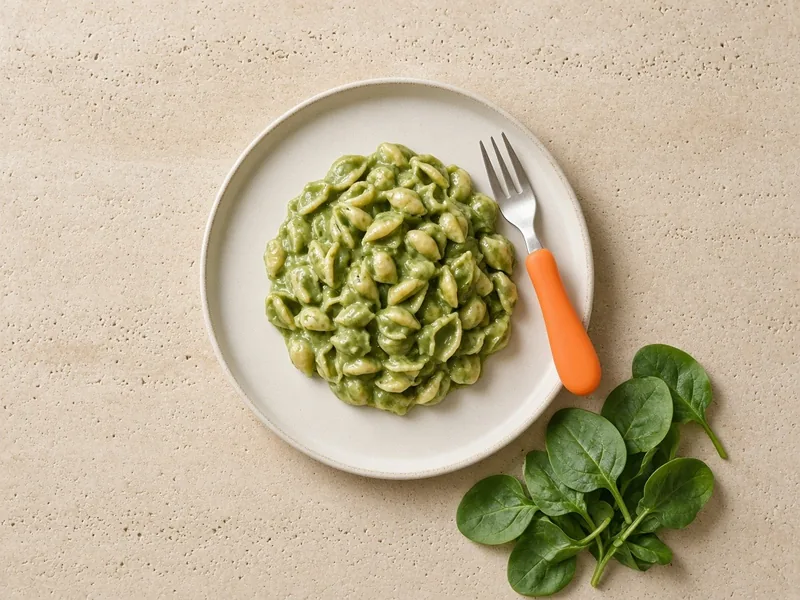
- From
- 12 months
- Time
- 25 min
- Makes
- 2 adults and 1 toddler, with spare pesto
Contains milkContains wheatOptional extra contains tree nuts
Ingredients
- 250 g (9 oz)dried wheat pastaplain wheat pasta with no egg (check the label); small shapes such as small shells or fusilli
- 100 g (3½ oz)fresh spinachor the same weight of frozen spinach
- 1 small bunch (20 g / ¾ oz)fresh basil
- 4 tbspolive oil
- 20 g (¼ cup)finely grated parmesanmade from pasteurized milk (check the label). It's salty, so keep to this amount
- 1 small clovegarlicoptional; cooked first, never raw
- 30 g (¼ cup)plain, unsalted pine nutsoptional. Pine nuts are tree nuts: use them only once your child has had them finely ground on their own without a reaction, on a day they're well, at home, when you can watch them for a couple of hours afterward. If your child has a peanut or tree nut allergy, ask your allergist before offering pine nuts. Leave them out for a nut-free pesto
Steps
- 1Wash your hands. Rinse the spinach and basil under running water, gently rubbing the leaves. Remove any thick spinach stems and pick the basil leaves off their stems. Check the parmesan label says it's made from pasteurized milk, then grate it finely.
- 2Boil the pasta in plenty of unsalted water for a few minutes longer than the package says, until a piece squashes easily between your fingers. Save a mug of the cooking water, then drain.
- 3Meanwhile, wilt the spinach in a pan with a splash of water for 2 to 3 minutes, until very soft and dark green (cook frozen spinach until it's steaming hot all the way through). Tip it into a sieve, let it cool a little and squeeze out the water. If you're using garlic, chop it finely and cook it gently in 1 tablespoon of the oil for 1 to 2 minutes, until soft but not brown, then let it cool.
- 4If you're using pine nuts, grind them to a fine powder first. Blend the spinach, basil, garlic and its oil, the rest of the oil, the parmesan and 2 to 3 tablespoons of the cooking water until completely smooth. Don't add salt. Rub a little between your thumb and finger: it should feel smooth, with no bits of leaf or nut.
- 5Take your toddler's portion of pasta out first and stir in a teaspoon or two of pesto, with a splash of cooking water if it's thick. Stir more pesto through the family pasta. Let your toddler's portion cool, stir, and check it's only just warm before serving.
How to serve it by age
12 months+
Once your child has had wheat and dairy each on their own without a reaction (and pine nuts, if you used them), serve small shapes or pasta pieces about 1 cm (just under ½ inch), with a teaspoon or two of pesto stirred through. Pesto is a flavor, not the main part of the meal. Your child decides how much to eat.
18 months+
Serve your child's portion of the unsalted pasta in bite-sized pieces about 1 cm (just under ½ inch), cutting any long strands short. Keep the pesto stirred through rather than spooned on top, and never add whole or toasted pine nuts to your child's plate: whole nuts wait until at least 4 years (5 in the UK).
Where US and UK guidance differ on this recipe
United States(AAP and CDC)Your setting
The AAP says not to give whole peanuts or tree nuts (pine nuts are tree nuts) to babies or young children because they are choking hazards, and to wait for whole peanuts until a child can chew them well, usually at least 4 years. Finely ground nuts blended smooth into pesto are fine. The CDC lists hard cheese such as parmesan among safer choices for children under 5, and dairy made from unpasteurized milk as riskier.
United Kingdom(NHS)Your setting
The NHS says no whole nuts for children under 5, while crushed or ground nuts added to food are fine. It says children aged 1 to 3 should have no more than 2 g of salt a day and to eat salty foods such as cheese in small amounts, and that unpasteurised cheese is better avoided unless it's cooked in a recipe, because of listeria. Stirring pesto into hot pasta doesn't cook the cheese, so use pasteurised parmesan.
We cover US and UK guidance in detail. Elsewhere, check your national health service's advice too.
If your baby reacts
This recipe contains milk, wheat. The optional extras contain tree nuts. Introduce one new allergen at a time, mixed into a food your baby already eats, before serving it in a dish with other new foods. Contact your pediatrician, GP or health visitor if you notice mild signs after eating, such as a few hives or a little vomiting. See signs of a reaction.
Call 911999your local emergency number (such as 112 in Europe or 000 in Australia) now if your baby has trouble breathing, wheezing, can't cough or cry, has lips, mouth, tongue or throat that suddenly swell, or becomes pale, bluish, floppy or unresponsive. Also call if hives come with repeated vomiting.
Leftovers and the rest of the family
Storing it
Cool leftover pasta quickly and keep it covered in the fridge for 3 to 4 days. Spare pesto keeps in a covered jar in the fridge for 3 to 4 days, or freeze it in small portions, such as in an ice cube tray, for 2 to 3 months. Thaw it in the fridge and use it within 24 hours of thawing. Reheat leftover pasta only once, until steaming hot, 165°F (74°C), with a splash of water so it doesn't dry out, then let it cool before serving. Throw away anything left in your child's bowl. Don't leave it at room temperature for more than 2 hours, or 1 hour if it's hotter than 90°F (32°C).

For the grown-ups
Take your toddler's portion out first, then add a pinch of salt, black pepper, extra parmesan and a few toasted pine nuts to the adults' pasta. Salt, extra cheese and whole nuts go on the adults' plates only.
Foods in this recipe



Free printable: The First 100 Foods checklist
Tick off foods as your baby tries them. Print it or save it as a PDF, no sign-up needed.
Sources
- NHS: Foods to avoid giving babies and young children
- NHS: Food allergies in babies and young children
- NHS: Salt in your diet
- AAP: When to introduce egg, peanut butter and other common food allergens
- ACAAI: Tree nut allergy
- CDC: Safer food choices for children under 5
- USDA FSIS: Leftovers and food safety
- USDA FSIS: Freezing and food safety
- NHS Best Start in Life: Storing and reheating food