
Tuna pasta bake
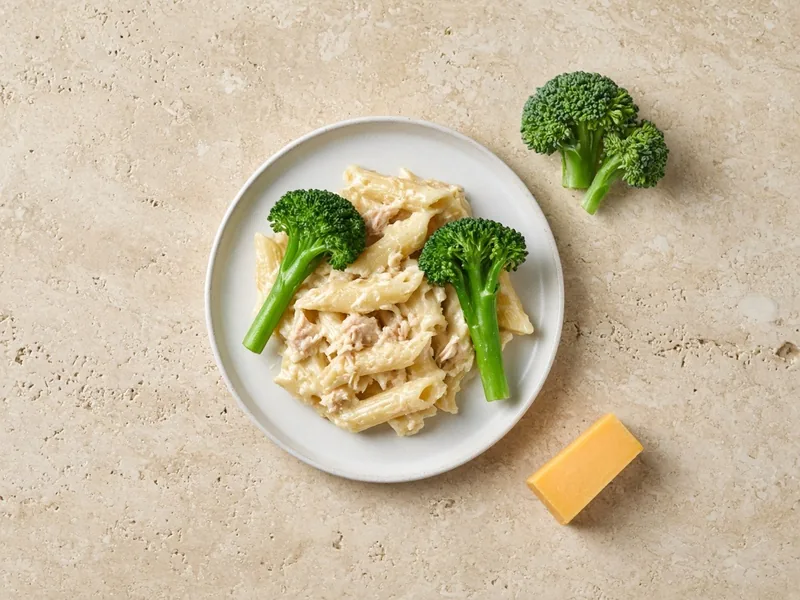
Soft pasta, flaked canned light tuna and very soft broccoli in a simple cheese sauce, baked until bubbling, with no added salt. Contains fish, milk and wheat: offer it once your baby has had each on its own.
- From
- 6 months
- Time
- 45 min
- Makes
- 2 adults and 1 baby, with leftovers
Contains fishContains milkContains wheat
Ingredients
- 250 g (9 oz)dried wheat pastaplain wheat pasta with no egg (check the label); large shapes such as penne or fusilli for a younger baby to grip
- 1 can (about 145 g / 5 oz)canned light tuna in waterlight tuna (often skipjack), packed in water with no salt added, not in brine. Light tuna is the low-mercury choice; see the US and UK note below
- 1 small head (200 g / 7 oz)broccolilarge florets with a long stem for a 6-month-old, small pieces for older children
- 25 g (2 tbsp)unsalted butter
- 25 g (3 tbsp)plain (all-purpose) flour
- 400 ml (1⅔ cups)whole cow's milkpasteurized; see the US and UK note below for babies under 12 months
- 50 g (½ cup)finely grated hard cheesepasteurized and full-fat, such as mild cheddar; compare labels and choose a lower-salt one. Cheese is salty, so keep to this amount
Steps
- 1Wash your hands. Rinse the broccoli under running water. For a 6-month-old, cut a few large florets with a long stem, about 7–10 cm (3–4 in) in total, and peel the tough outer layer off thick stems. Cut the rest into small florets. Check the cheese label says it's made from pasteurized milk, then grate it finely. Heat the oven to 200°C (400°F).
- 2Boil the pasta in plenty of unsalted water for a few minutes longer than the package says, until a piece squashes easily between your fingers. Add the broccoli for the last 6 to 8 minutes, until a floret squashes easily too. Drain both.
- 3Meanwhile, melt the butter in a pan over low heat, stir in the flour and cook for 1 minute. Take the pan off the heat and add the milk a little at a time, stirring until smooth. Put it back on medium-low heat and keep stirring for about 5 minutes, until the sauce thickens and bubbles gently. Take it off the heat and stir in most of the cheese. Don't add salt.
- 4Drain the tuna, rinse it briefly, then flake it with a fork, picking out any hard bits of bone or skin. If you follow US advice on cow's milk for a baby under 12 months, set your baby's pasta, broccoli and tuna aside now (see the US and UK note). Fold the pasta, broccoli and tuna into the sauce, spread it in a baking dish and scatter the rest of the cheese on top.
- 5Bake for 15 to 20 minutes, until the sauce bubbles at the edges and the middle is steaming hot, 165°F (74°C).
- 6Take your baby's portion from the middle of the dish, leaving off any crisp or browned edges, and spread it in a shallow bowl. Let it cool, stirring, and check it's only just warm before serving: cheese sauce holds heat.
How to serve it by age
6 months+
Once your baby has had fish, dairy and wheat each on their own without a reaction, offer a few large, very soft pasta shapes coated in sauce and the large broccoli florets, with the stem as a handle, to grab. Squash a floret between your thumb and finger first: it should flatten easily. Or mash some pasta with the tuna and sauce and serve it on a pre-loaded spoon.
9 months+
Cut the pasta into pieces no bigger than about 1 cm (just under ½ inch), or use small shapes, with small, moist flakes of tuna and the broccoli chopped small.
12 months+
Serve the family dish, with pasta in small shapes or pieces about 1 cm (just under ½ inch). Keep checking the tuna for hard bits of bone, and leave off crunchy edges until your child chews well.
Where US and UK guidance differ on this recipe
United States(AAP and CDC)Your setting
The CDC says not to give cow's milk before 12 months. If you follow US advice, use breast milk or formula instead: take your baby's portion of pasta, tuna and broccoli out before the sauce goes in, and mash it with a little breast milk or formula just before serving. The FDA lists canned light tuna (including skipjack) as a 'Best choice' for low mercury and albacore (white) tuna as a 'Good choice'. For ages 1 to 3, a serving is about 1 oz (28 g), 2 servings a week from the 'Best choices' list; it doesn't give a serving size for babies under 12 months.
United Kingdom(NHS)Your setting
The NHS says cows' milk can be used in cooking or mixed with food from around 6 months, but shouldn't be given as a main drink until 1 year. Canned tuna doesn't count as oily fish, and the NHS gives no weekly tuna limit for children: its limit of 4 cans a week is for people trying for a baby or pregnant. Children under 16 shouldn't eat shark, swordfish or marlin.
We cover US and UK guidance in detail. Elsewhere, check your national health service's advice too.
If your baby reacts
This recipe contains fish, milk, wheat. Introduce one new allergen at a time, mixed into a food your baby already eats, before serving it in a dish with other new foods. Contact your pediatrician, GP or health visitor if you notice mild signs after eating, such as a few hives or a little vomiting. See signs of a reaction.
Call 911999your local emergency number (such as 112 in Europe or 000 in Australia) now if your baby has trouble breathing, wheezing, can't cough or cry, has lips, mouth, tongue or throat that suddenly swell, or becomes pale, bluish, floppy or unresponsive. Also call if hives come with repeated vomiting.
Leftovers and the rest of the family
Storing it
Cool leftovers quickly in a shallow container and keep them covered in the fridge for 3 to 4 days, or freeze them in small portions for 2 to 3 months (the sauce may turn a little grainy). Thaw frozen portions in the fridge and eat them within 24 hours of thawing. Reheat only the portion you need, and only once, until steaming hot, 165°F (74°C), stirring in a splash of water if it's thick, then let it cool before serving. Throw away anything left in your baby's bowl. Don't leave it at room temperature for more than 2 hours, or 1 hour if it's hotter than 90°F (32°C).

For the grown-ups
Take your baby's portion out first, then season the adults' portions with black pepper and a little salt, or add extra cheese on top. Serve with a green salad for the adults.
Foods in this recipe





Free printable: The First 100 Foods checklist
Tick off foods as your baby tries them. Print it or save it as a PDF, no sign-up needed.
Sources
- FDA: Advice about eating fish
- NHS: Fish and shellfish
- NHS: Your baby's first solid foods
- NHS: Salt in your diet
- CDC: Cow's milk and milk alternatives
- USDA FSIS: Safe minimum internal temperature chart
- USDA FSIS: Leftovers and food safety
- USDA FSIS: Freezing and food safety
- NHS Best Start in Life: Storing and reheating food